

Table of Contents
- Why Your Daily Step Count Matters More Than You Think
- Benefits of 10,000 Steps a Day (And Why the Number Works)
- How to Walk More at Work (Even at a Desk Job)
- Best Pedometer Apps to Track Your Progress
- A Step-by-Step Plan to Increase Your Daily Step Count
- Injury Prevention, Footwear, and Walking Safely
- The Easiest Tool for Hitting Your Step Goal at Home
- Conclusion
Last Updated: August 10, 2026
Why Your Daily Step Count Matters More Than You Think
Most people underestimate how their daily step count shapes long-term health. Remote professionals face a particular challenge: a full calendar, limited space, and sedentary work that eliminates incidental movement. Incidental exercise, physical activity accumulated through ordinary movement rather than dedicated workouts, has nearly vanished from desk-based jobs. You don't walk to meetings, commute, or visit colleagues' desks. The result is activity so low that even moderate exercise sessions struggle to compensate.
The good news: small, consistent changes compound into real results. This guide covers the science behind step goals, practical strategies for desk workers, step-tracking accuracy, and a realistic plan for building the habit without burnout.
CDC physical activity guidelines for adults
Benefits of 10,000 Steps a Day (And Why the Number Works)
The 10,000-step target originated as a marketing concept from a Japanese pedometer campaign in the 1960s, not a clinical recommendation. Its real value is behavioral: it gives you something concrete to chase. Whether your target is 7,000 or 12,000 depends on your starting point and health objectives. Research consistently shows that more steps correlate with better health outcomes up to a meaningful threshold.
Cardiovascular Health and Weight Management
Regular walking at moderate intensity supports cardiovascular health by keeping your heart rate elevated and improving circulation. For sedentary desk workers, this is especially important: prolonged sitting compresses circulation and reduces metabolic efficiency. Adding a walking routine, even in short bursts, counteracts these effects. According to American Heart Association guidance on physical activity, adults benefit from at least 150 minutes of moderate-intensity activity per week, and walking is one of the most accessible ways to reach that target.
Metabolic Health and Mental Wellness
Walking improves insulin sensitivity and helps regulate blood glucose levels, particularly after meals. A ten-minute walk after lunch can meaningfully affect how your body processes food. Mental wellness benefits are equally real: regular physical activity is associated with reduced anxiety, improved mood, and better cognitive focus, particularly valuable for remote workers spending hours at a screen.
How to Walk More at Work (Even at a Desk Job)
The biggest obstacle to increasing daily step count isn't motivation; it's structure. Without a commute or reason to move between rooms, steps simply don't happen. The most effective approach is to attach walking to things you're already doing. Habit researchers call this "habit stacking," and it works because it removes the decision entirely.
Movement Breaks and Incidental Exercise
Movement breaks are short, intentional pauses from sitting, typically two to five minutes every thirty to sixty minutes. They're not workouts; they're resets. A lap around your apartment, a walk to the kitchen, or a few minutes stepping in place all count. Set a recurring reminder on your phone or computer. After two weeks, the habit typically forms and the reminder becomes redundant.
Incidental exercise works similarly: take the stairs, park further away, walk during phone calls. These micro-decisions add hundreds of steps per day without requiring dedicated workouts.
Work-From-Home Strategies That Actually Add Steps
- Walk during calls. Any call not requiring video is a walking opportunity with wireless earbuds.
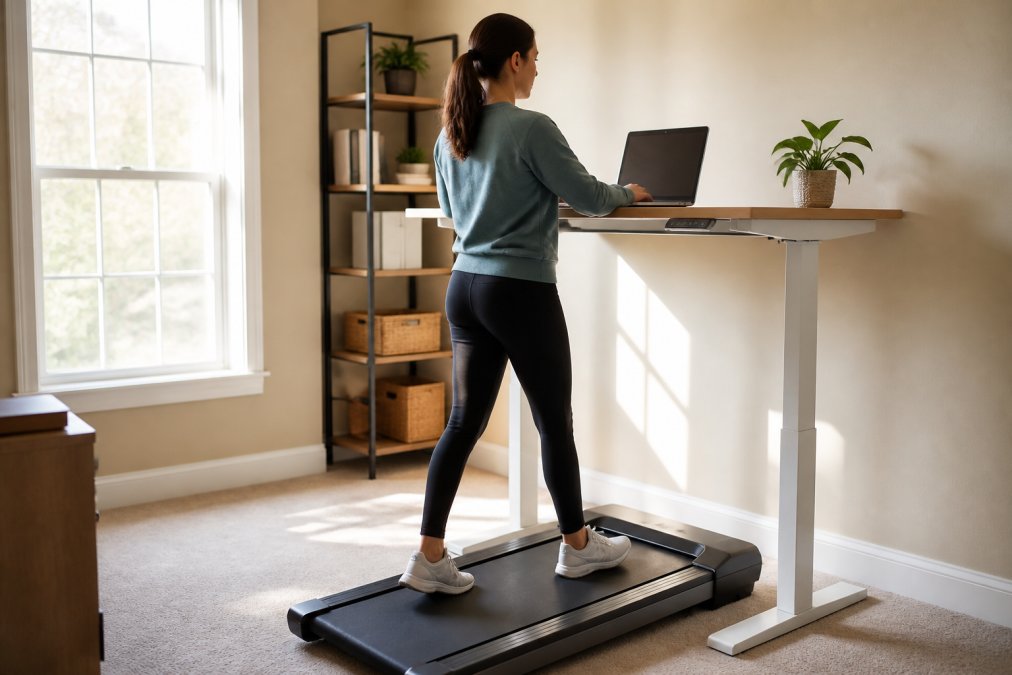
- Use a walking treadmill under your desk. At 1-2 mph, you can walk and type simultaneously.
- Set a step goal before noon. Front-loading steps means you're not scrambling at 9 PM.
- Walk to get water, coffee, or meals. Make each trip separate rather than batching them.
- Schedule walking meetings. Suggest phone catch-ups while walking.
Best Pedometer Apps to Track Your Progress
Tracking your step count is essential for habit formation. Most people significantly overestimate their activity without data. The best pedometer apps include built-in health apps like Apple Health and Google Fit, as well as dedicated trackers that sync with wearables.
Key features to look for: daily and weekly summaries, goal setting with notifications, historical data for spotting trends, and integration with native health platforms.
Step-Tracking Accuracy: What the Numbers Really Mean
Your step count is an estimate, not a measurement. Pedometers use accelerometers to detect motion and infer steps. They're reasonably accurate during steady walking on flat ground but less accurate during slow shuffling, stair climbing, or arm-movement activities like cycling.
Practical implications: don't obsess over precision, 8,400 versus 8,600 steps is not meaningfully different. Trend direction matters more than daily exactness. Wrist-based trackers are generally more consistent than phone-based ones. If you switch trackers, give yourself a week to establish a new baseline. The goal of tracking is awareness and accountability, not clinical precision.
A Step-by-Step Plan to Increase Your Daily Step Count
The most common failure is jumping from 3,000 to 10,000 steps in a week. Gradual progression is essential.
| Week | Daily Step Target | Key Strategy | Frequency |
|---|---|---|---|
| 1-2 | Current average + 500 | Add one movement break per day | Daily |
| 3-4 | Current average + 1,000 | Add walking during calls | Daily |
| 5-6 | Current average + 1,500 | Front-load steps before noon | Daily |
| 7-8 | Current average + 2,000 | Introduce under-desk walking | Daily |
| 9+ | Target step goal | Combine all strategies | Daily |
Gradual Progression: Building the Habit Without Burnout
Add 500 steps per week to your current baseline. At that pace, someone starting at 3,000 daily steps reaches 10,000 in fourteen weeks without feeling like they're grinding. Each week feels achievable, building momentum and confidence.
Track your baseline for three days before changing anything. Most sedentary desk workers discover they're walking far less than assumed, useful information rather than discouraging news.
Overcoming Psychological Barriers to More Movement
Action precedes motivation, not the other way around. Common barriers and solutions:
- "I don't have time." Walking during calls, on a treadmill while working, or during breaks requires no additional time.
- "I'll start on Monday." Starting Tuesday with a modest goal beats waiting for the perfect moment.
- "I tried before and it didn't stick." The issue was likely too-large initial steps, not a character flaw.
- "My apartment is too small." An under-desk treadmill removes this constraint entirely.
According to American Psychological Association research on habit formation, habits form through consistent repetition in stable contexts, not through willpower alone. Make walking the default, not the exception.

Injury Prevention, Footwear, and Walking Safely
Walking is low-risk, but increasing your step count significantly and quickly raises the chance of overuse injuries in the feet, knees, and hips. Supportive shoes with adequate cushioning protect your joints during extended sessions, especially on hard home floors.
Key prevention principles: increase gradually, wear proper footwear, pay attention to pain signals (mild fatigue is normal; sharp joint pain is not), and stretch calves, hamstrings, and hip flexors before and after long sessions.
The Easiest Tool for Hitting Your Step Goal at Home
For remote workers, the biggest barrier to increasing daily steps is the absence of space and opportunity to walk. You can't walk to work or take stairs if you're already home.
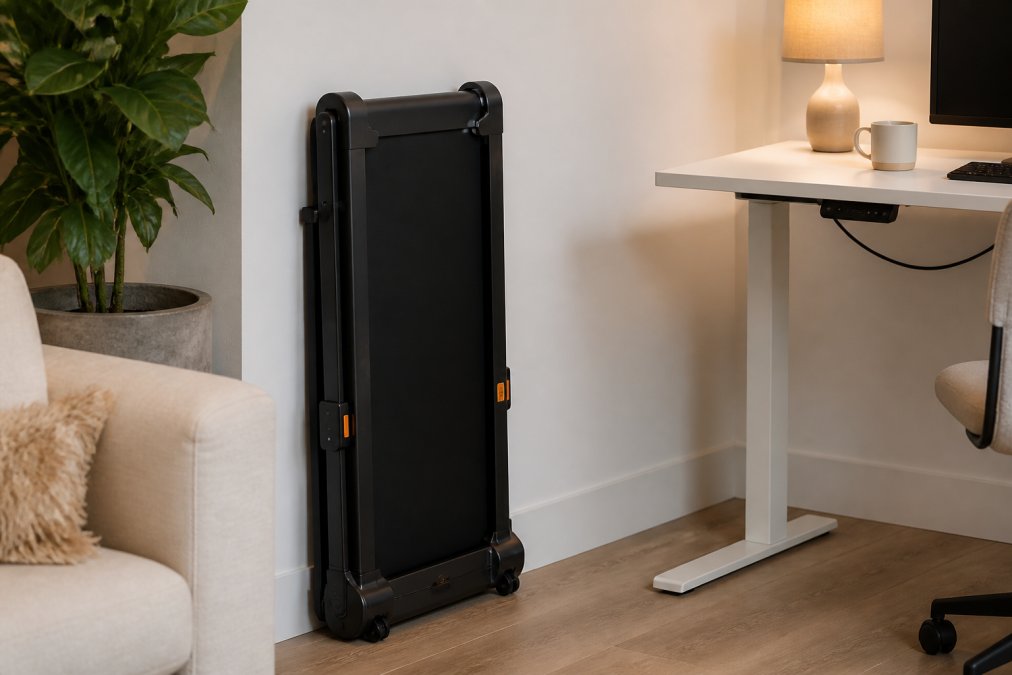
The Wild Bloom portable under-desk treadmill solves this directly. At $149.99, it's priced well below most alternatives. The motor runs below 45 dB, quieter than normal conversation and unlikely to register on video calls. The anti-slip belt with shock absorption protects your joints, and the foldable design stores flat against a wall or in a closet when not in use.
No-assembly design means it's ready immediately. Built-in transport wheels make it easy to move between rooms. Walking at 1-2 mph while working is comfortable enough to type, take calls, and maintain focus. Many users accumulate 5,000-8,000 additional steps per day without dedicating extra hours to exercise.
You can find the Wild Bloom portable under-desk treadmill at getwildbloom.org.
As noted by Mayo Clinic guidance on walking for health, walking is one of the most effective and accessible forms of physical activity for adults of all fitness levels, and removing barriers to entry is the most reliable way to build consistency.
Increasing your daily step count is one of the most evidence-backed changes you can make for cardiovascular health, metabolic health, and mental wellness. The challenge for remote professionals isn't knowledge; it's opportunity. Wild Bloom's portable under-desk treadmill removes the biggest obstacle: it brings walking to you, quietly, without assembly, and without taking over your apartment. Get started with Wild Bloom and build a step count that reflects how much you care about your health.
Frequently Asked Questions
What's the easiest way to get 10,000 steps a day?
The most sustainable approach is spreading steps throughout the day rather than saving them for one walk. Stack movement onto existing habits: walk during phone calls, take stairs instead of elevators, park further from your destination, and use short movement breaks every hour. For remote workers, a compact under-desk treadmill lets you accumulate steps while you work, making 10,000 steps achievable without setting aside dedicated exercise time.
How can I track my steps accurately without a dedicated fitness tracker?
Most smartphones have built-in pedometers using the device's accelerometer. Apps like Apple Health, Google Fit, and Samsung Health track steps passively as long as your phone is on you. For better accuracy, keep your phone in a pocket rather than a bag. These apps are reliable for daily totals, though they can undercount steps taken while your phone sits on a desk. A wrist-worn fitness tracker generally gives the most consistent readings across all activities.
Does walking in place count toward my daily step goal?
Yes. Walking in place activates the same muscles and registers on pedometers and fitness trackers just like forward walking. It's a practical option for apartment dwellers or anyone in a small space. Marching in place during TV commercials, while on hold, or during short work breaks can add several hundred steps in just a few minutes. Over a full day, those small sessions contribute meaningfully to your total activity level and overall physical activity.
How do I stay motivated to increase my step count long-term?
Set a step goal that's slightly above your current average rather than jumping straight to 10,000. Tracking progress visually, whether through an app or a simple log, reinforces the habit. Social accountability helps too: share goals with a colleague or join a step challenge. Removing friction matters most for long-term consistency. Equipment that's always ready to use, like a foldable under-desk treadmill, makes it easier to keep your walking routine going even on the busiest days.
What is the 6-6-6 rule for walking?
The 6-6-6 rule is a structured walking framework: walk for 60 minutes total, split into a 6-minute warm-up, 6 minutes of moderate-intensity walking, and a 6-minute cool-down, repeated across the day. Some versions interpret it as walking 6 days a week, 6 miles, with 6-minute warm-up and cool-down periods. The exact definition varies by source, but the core principle is consistent: structured, moderate-intensity walking sessions spread through the week support cardiovascular health and sustainable habit formation.
How do I increase my daily step count if I work from home?
Working from home removes the natural steps that come from commuting and moving around an office. Compensate by building deliberate movement into your schedule: walk during every phone or video call you don't need to be on camera for, set hourly reminders to take a two-minute walk, and add a short outdoor walk before or after your workday. A compact under-desk treadmill is particularly effective for remote workers because it adds steps during actual work hours without requiring separate workout time.
This article was written using GrandRanker