

Table of Contents
- Assess Your Closet Space and Treadmill Dimensions
- Prepare Your Treadmill for Closet Storage
- Choose Your Storage Method: Vertical vs. Horizontal
- Install Wall Mounts and Heavy-Duty Hooks
- How to Use a Walking Pad on Carpet Without Damage
- Implement Safety Precautions for Upright Storage
- Step-by-Step Retrieval and Setup Process
- Conclusion
Last Updated: August 24, 2026
Assess Your Closet Space and Treadmill Dimensions
Storing a treadmill in your closet requires careful planning. The most common mistake is assuming your closet is large enough without measuring first. A treadmill that won't fit through the doorway or stand upright becomes an expensive storage problem.
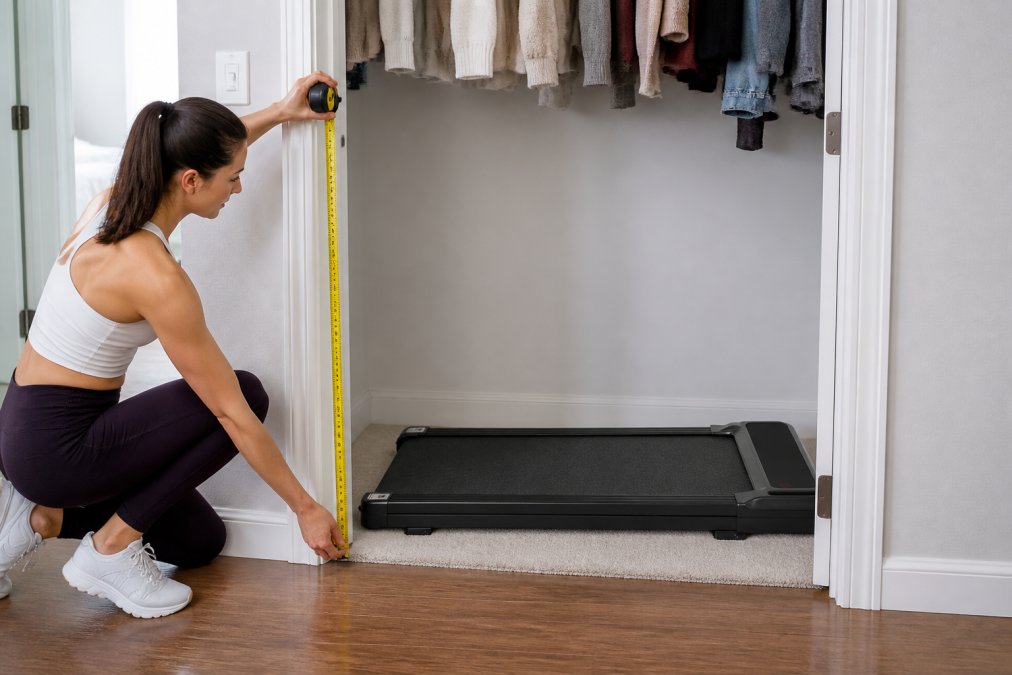
Start by measuring three critical dimensions: doorway width, closet depth, and ceiling height. Most standard doorways are 32 to 36 inches wide (ada.gov). If your treadmill is wider than your doorway when folded, you'll need to store it horizontally or disassemble it partially. Measure the actual opening; trim and hinges reduce usable space.
Next, measure your closet floor from the back wall to the interior edge of the door frame. This determines whether you can store a treadmill lying flat or if you must position it vertically. Closet ceilings typically range from 7 to 8 feet in residential spaces.
Measuring for Vertical and Horizontal Storage
Vertical storage demands more ceiling height but preserves floor space. You need at least 6.5 feet of clearance from floor to ceiling. Measure from the floor to any light fixtures, shelving brackets, or ventilation ducts that might interfere.
Horizontal lay-flat storage requires different measurements. Most folding models range from 48 to 60 inches long. Your closet depth must accommodate this length plus a few inches for safe handling and airflow. If your closet is only 24 inches deep, horizontal storage won't work.
Write down all measurements and compare them to your treadmill's specifications. The Wild Bloom portable treadmill folds to approximately 28 inches long and 18 inches wide, making it compatible with most standard closets when positioned vertically or on its side.

Checking Structural Load-Bearing Capacity
Wall-mounted storage requires verification that your closet walls can support the weight. Most residential closets have standard 2x4 inch wooden studs spaced 16 inches apart, which can safely support 50 to 100 pounds each when properly anchored (doi.org).
Before mounting anything, locate the studs using a stud finder and mark their locations. Drywall alone cannot support a treadmill's weight; fasteners must penetrate into the studs themselves. If your closet has drywall-only walls without accessible studs, use floor-based storage instead.
Check your treadmill's weight. Most compact folding models weigh between 50 and 150 pounds (peer-reviewed research). Distribute this weight across multiple mounting points. A single hook cannot safely hold a treadmill; you need at least two heavy-duty hooks positioned at different heights and anchored into separate studs.
If you're unsure about your wall's structural integrity, consult a contractor or skip wall mounting entirely.
Prepare Your Treadmill for Closet Storage
Before storing your treadmill, prepare it properly to ensure it stays functional and protected. Neglecting this step leads to rust, motor failure, and belt degradation.
Cleaning and Inspection Checklist
Start with a thorough cleaning. Use a soft, dry cloth to wipe down the entire frame, removing dust, sweat residue, and debris. Pay special attention to the belt and motor housing.
Inspect the belt for cracks, fraying, or uneven wear. Look for any debris stuck under the belt and clear it away gently with a dry brush. Never use water or cleaning solutions on the belt or motor area.
Check the frame for visible damage, loose bolts, or bent components. Tighten any loose fasteners. Inspect the folding mechanism and locking pins, then apply a light silicone-based lubricant to hinges and pivot points. This prevents rust and ensures smooth operation when you retrieve the treadmill.
Cable Management and Power Cord Safety
Never store a treadmill with the power cord wrapped tightly around the frame. Tight wrapping damages the cord insulation, creating a fire or shock hazard.
Coil the power cord loosely in a figure-eight pattern and secure it with a velcro cable tie or rubber band. Keep the cord separate from the treadmill frame to prevent crushing or pinching.
Unplug the treadmill before storage. Store the power cord in a separate plastic bag or cable organizer to protect it from moisture and accidental damage. If your treadmill has a safety key, store it separately in a labeled container.
Choose Your Storage Method: Vertical vs. Horizontal
The storage method you choose depends on your closet dimensions, the treadmill's design, and how frequently you'll retrieve it.
Vertical Storage with Folding Mechanisms
Vertical storage maximizes closet floor space and works well for compact folding treadmills like the Wild Bloom portable model. Before storing vertically, verify that the locking mechanism engages fully and holds the treadmill in folded position without wobbling.
Position the folded treadmill in a corner of your closet, away from the door path. Ensure the folded unit doesn't lean against walls or shelving in a way that could damage the frame. Use a rubber stopper or wedge beneath the folded treadmill to prevent it from sliding on smooth closet floors.
Horizontal Lay-Flat Storage on the Floor
Horizontal storage works when your closet has sufficient depth. Lay the treadmill on its side or back, depending on the design, with the belt and motor facing upward to prevent dust from settling on sensitive components.
Use furniture sliders or rubber shims beneath the treadmill to protect the closet floor and allow for easier retrieval. These inexpensive accessories prevent scratches and make it simpler to slide the equipment out when needed.
Install Wall Mounts and Heavy-Duty Hooks
Wall-mounted storage is ideal when floor space is extremely limited. This method requires careful installation to ensure safety and equipment protection.
Finding Studs and Securing Anchors
Use an electronic stud finder to locate wall studs behind your closet drywall. Mark each stud location with a light pencil mark. Studs are typically 16 inches apart.
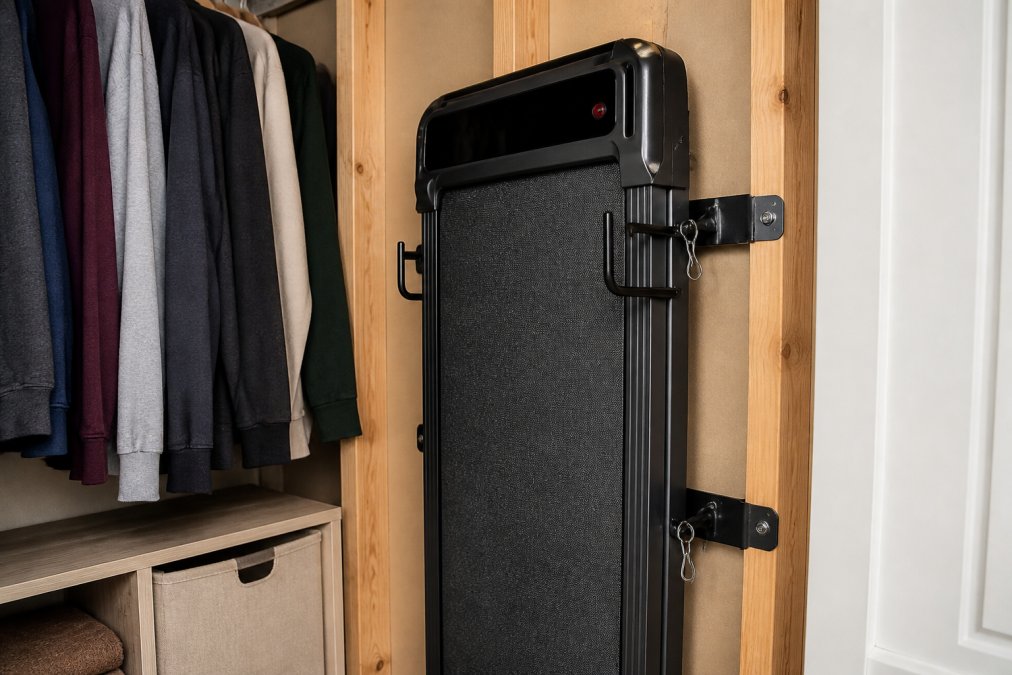
Mark the mounting points where you'll install hooks. For a treadmill, plan two mounting points at least 24 inches apart horizontally, positioned at approximately 5 to 6 feet high. Drill pilot holes at your marked locations and install heavy-duty lag bolts or wood screws directly into the studs.
If studs aren't conveniently positioned, do not use drywall anchors alone. Drywall anchors are designed for light loads and will fail under a treadmill's weight. Relocate your mounting points to align with studs, or use floor storage instead.
Weight Distribution and Safety Pins
Install heavy-duty hooks rated for at least 150 pounds each. These hooks should have a curved design that prevents the treadmill from sliding off accidentally. Test each hook by hanging a weight equal to or greater than your treadmill's weight before relying on it.
Use safety pins or carabiners to secure the treadmill to the hooks. These secondary fasteners prevent accidental dislodging if the hooks shift or if the treadmill is bumped. Never hang a treadmill by cables or straps alone; the primary support must come from solid hooks anchored into studs.
How to Use a Walking Pad on Carpet Without Damage
Protecting Flooring During Storage and Retrieval
Use furniture sliders or moving blankets beneath your treadmill when sliding it in or out of the closet. These materials reduce friction and prevent scratches on carpet, tile, or hardwood floors.
If you're storing the treadmill on carpet, place a moisture barrier (plastic sheeting or a tarp) beneath it. This prevents humidity absorption and mold growth on the carpet underneath. For retrieval, ask for help if the treadmill is heavy. Clear the pathway from the closet to your exercise area before attempting retrieval.
Closet Ventilation and Humidity Control
Closets are naturally humid environments. High humidity accelerates rust formation and can damage electronics. Ensure your closet has adequate airflow by leaving the door slightly ajar or installing a small closet vent.
In humid climates, consider placing a moisture-absorbing product like silica gel packets or a small dehumidifier in the closet. If your closet shows signs of mold or mildew, address the humidity problem before storing your treadmill.
Implement Safety Precautions for Upright Storage
Vertical storage requires additional safety measures to prevent accidents and equipment damage.
Locking Mechanisms and Hydraulic Lift Systems
If your treadmill has a hydraulic lift system, inspect it regularly for leaks or loss of pressure. Test the system monthly by folding and unfolding the equipment gently.
Verify that all locking pins are present and functional. These pins hold the treadmill in folded position and prevent accidental unfolding. Check that locking mechanisms engage with an audible or tactile click.
Securing Cables and Preventing Accidental Activation
Route all cables away from the treadmill's moving parts and folding hinges. Coil excess cable length neatly and secure it with velcro ties. Keep the power cord separate from the treadmill frame.
Store the safety key separately from the treadmill. This prevents accidental activation if someone unfamiliar with the equipment attempts to use it.
Step-by-Step Retrieval and Setup Process
Retrieving your treadmill from closet storage requires care to prevent damage and ensure safe operation.
Using Transport Wheels and Manual Handling
If your treadmill has built-in transport wheels, use them to move the equipment. Roll it gently on a clear, level surface. For equipment without wheels, use furniture sliders beneath the frame and slide the treadmill slowly toward the exit.
Clear the pathway from the closet to your exercise area. Remove obstacles, cords, and clutter that could cause tripping or equipment collision.
Checking Equipment Before First Use
Before using the treadmill after storage, perform a safety inspection. Check the belt for debris or damage. Inspect the frame for cracks or loose components. Verify that all fasteners are tight.
Test the folding mechanism by gently folding and unfolding the equipment. Plug in the treadmill and test all electronic functions without stepping on the belt. Start at the lowest speed setting and walk briefly to ensure smooth operation before resuming normal use.
Storing a treadmill in your closet is achievable with proper planning and preparation. The challenge most people face is balancing space constraints with safety and equipment longevity. Wild Bloom's portable under desk treadmill addresses this directly with its compact folding design, built-in transport wheels, and no-assembly setup, features specifically engineered for professionals with limited storage space. Whether you choose vertical or horizontal storage, the key is ensuring your closet can safely accommodate your equipment and that you prepare the treadmill properly before storage. Following these steps protects your investment and keeps your equipment ready for consistent use.
Frequently Asked Questions
Can you store a folding treadmill upright in a closet?
Yes, many folding treadmills can be stored upright if your closet has adequate vertical clearance and structural support. Upright storage saves significant floor space, making it ideal for small apartments. Ensure your treadmill has secure locking mechanisms and safety pins to prevent accidental unfolding. Check the manufacturer's guidelines first, as some models are designed specifically for vertical storage while others should only be stored horizontally. Compact, foldable models like the Wild Bloom portable under desk treadmill are engineered for space-saving storage in tight closets.
Is it safe to store a treadmill in a small closet?
Safe closet storage requires three key conditions: proper ventilation to prevent moisture buildup, structural support rated for your treadmill's weight, and adequate clearance to prevent door damage or equipment tipping. Avoid storing treadmills in damp or humid closets, as moisture can damage the motor and electrical components over time. Install wall mounts or heavy-duty hooks only into wall studs capable of bearing the full weight. Keep the power cord unplugged and secured away from the door hinge. If your closet lacks ventilation, crack the door slightly or install a small vent to maintain airflow and prevent long-term damage to the equipment.
Does storing a treadmill upright damage the motor or lubrication system?
Proper upright storage does not damage the motor or lubrication if you follow maintenance steps before storing. Vertical positioning can affect motor oil distribution over extended periods, but modern treadmills are designed to handle this. Before storage, run the treadmill for 5-10 minutes to distribute lubrication evenly through the belt and motor components. Unplug the unit and allow it to cool completely. Store in a climate-controlled closet to minimize humidity exposure, which is the primary threat to motor longevity. Check the equipment quarterly by running it briefly to redistribute lubrication and ensure all moving parts remain functional.
How much closet space is needed for a foldable treadmill?
Most compact foldable treadmills require 24-36 inches of width, 12-18 inches of depth, and 48-60 inches of height when stored vertically. Horizontal storage typically needs 48-72 inches of length and 24-30 inches of width. Measure your closet carefully before purchasing. The Wild Bloom portable under desk treadmill is designed with a compact footprint and built-in transport wheels, making it easier to fit in tight spaces. Allow 2-3 extra inches of clearance on all sides to account for wall mounts, hooks, or protective padding. If your closet is smaller than these dimensions, consider wall-mounting the treadmill or using a pulley system to maximize available space.
This article was written using GrandRanker