

Table of Contents
- Why Sitting All Day Drains Your Energy and Health
- How to Stay Active With a Desk Job: The 3-Part Framework
- Desk Job Fitness Hacks for Cramped Offices
- The Benefits of Walking Treadmills for Office Workers
- Stretching and Posture Fixes You Can Do in Business Attire
- Common Mistakes to Avoid When Building Your Routine
- Your Next Step: Build a Routine You'll Actually Keep
- Frequently Asked Questions
Last Updated: September 7, 2026
Why Sitting All Day Drains Your Energy and Health
Sedentary work creates a paradox: the more you sit to conserve energy, the more exhausted you feel by mid-afternoon. Prolonged sitting slows blood circulation, which reduces oxygen flow to the brain and leaves you fighting fatigue instead of focusing on your tasks (peer-reviewed research). The stiffness in your neck, shoulders, and hips isn't just uncomfortable; it's a signal that your musculoskeletal system is adapting to a static position your body wasn't designed to hold.
The challenge of learning how to stay active desk job is real, but the solution doesn't require a gym membership or a complete career change. The key insight is that consistency matters more than intensity: short, frequent movement breaks produce better outcomes than an occasional hour-long workout followed by eight more hours of sitting.
The good news is that you don't need to overhaul your entire workday. You need a system that works around meetings, deadlines, and the social norms of a shared office. That's exactly what we'll build in this guide.
How to Stay Active With a Desk Job: The 3-Part Framework
A sustainable approach to staying active with a desk job rests on three pillars: movement breaks, ergonomic adjustments, and dedicated walking time. Most guides focus on only one of these, which is why their advice fails within a week. Your routine needs all three working together to overcome the physical and social barriers of office life.
The framework is simple: interrupt prolonged sitting every 30 to 45 minutes, maintain a neutral spine while you work, and accumulate 30 minutes of low-intensity walking throughout your day. This combination addresses blood circulation, joint mobility, and energy levels simultaneously. According to guidance from the American Heart Association on physical activity, adults should aim for at least 150 minutes of moderate-intensity aerobic activity weekly, but breaking that into walking sessions during the workday makes it achievable.
Movement Breaks That Fit Your Meeting Schedule
Your calendar is the biggest obstacle to movement, so use it as your tool. Schedule five-minute movement breaks between meetings rather than expecting yourself to remember mid-task. When you have back-to-back video calls, stand and stretch during transitions, or pace during calls where you're listening rather than presenting. These micro-breaks reset your posture and prevent the stiffness that builds after an hour of uninterrupted sitting.
Setting Movement Reminders and Timers That Work
Timer-based reminders fail when they interrupt deep work, so align them with natural workflow breaks instead. Set a timer for 45 minutes of focused work, then take a five-minute movement break before starting the next block. Use your activity tracker or phone to nudge you if you've been stationary too long, but treat the reminder as a prompt to stand, stretch, or walk, not as an interruption to your concentration.
Desk Job Fitness Hacks for Cramped Offices
Small spaces demand creative solutions, and the best desk job fitness hacks respect your physical constraints, your professional attire, and your need to stay focused. Most advice assumes you have a gym, a spare room, or the ability to change into workout clothes. In a cramped cubicle or shared office, that's rarely the reality. The unique angle here is movement that works within the dress code and the square footage you actually have.
Seated Exercises That Won't Wrinkle Your Suit
Your chair is a piece of exercise equipment. Seated exercises target the muscles that weaken from hunching forward and require no more space than your current setup. The key is to perform them with controlled movements that don't raise your heart rate enough to sweat through your shirt.
- Seated Knee Lifts: Sit tall with your spine neutral, then lift one knee toward your chest, lower it slowly, and alternate. This engages your core and hip flexors without moving your upper body, keeping your blazer or dress shirt wrinkle-free. Perform 10 per side.
- Chair Swivels for the Obliques: While seated, place your hands on your desk and gently rotate your torso to look over your right shoulder, then your left. This mobilizes your thoracic spine and works your obliques without any visible exertion.
- Isometric Core Brace: Sit away from your desk, place your hands on your thighs, and engage your abdominal muscles as if bracing for a light punch. Hold for 20 seconds. This builds core stability silently and is completely invisible to colleagues.
The 'Stairwell Sprint' Alternative for Professional Attire
If you're wearing business attire, a full sprint up the stairs will leave you flushed and creased. Instead, use the stairwell for a low-impact mobility circuit. Walk up one flight at a normal pace, focusing on squeezing your glutes with each step. At the landing, perform 10 calf raises holding the railing for balance. Walk down slowly. Repeat for five minutes. This elevates your heart rate modestly, activates your lower body, and doesn't cause the heavy breathing that would make you self-conscious in a shared space.
Desk Drawer Toolkit
A small toolkit in your drawer can turn micro-breaks into strength work. The most office-appropriate tools are those that are silent, compact, and don't require a mat on the floor.
- Resistance Bands: Keep a light-to-medium band in your drawer. For a seated row, loop the band around the legs of your chair, hold the handles, and pull your elbows back, squeezing your shoulder blades. This directly counters the forward-rounded posture from typing. Do 15 reps during a break.
- Hand Grips: A simple hand grip strengthener works your forearms and can be used one-handed while you read a document. This is a subtle way to build grip strength without leaving your desk.
The 'Under-Desk' Cycle
For those who want continuous movement without the footprint of a treadmill, an under-desk pedal exerciser is a viable option. It's silent, fits in most knee wells, and allows you to pedal at a low resistance while you type. The trade-off is that it primarily works your legs and doesn't engage your upper body or core. It's a good option for days when you need to stay put but want to avoid the stiffness of sitting still.
The 'Walking Meeting' Hack for the Office
If you have a one-on-one meeting or a brainstorming session, suggest a walking meeting. This works best for two people, not large groups. Walk at a conversational pace around the building's perimeter or a nearby block. This not only adds steps but often leads to more creative discussions, as the change of scenery stimulates thinking. It's a professional norm that's gaining acceptance, and it sidesteps the issue of being seen as 'not working' while moving.
The Social Constraint
The biggest barrier in a cramped office isn't physical space; it's social perception. Colleagues may misinterpret your stretching or pacing as a lack of focus. To counter this, frame your movement as a productivity tool. If someone asks, you can say, "I'm just resetting my posture to stay focused for the afternoon." This normalizes the behavior and may even encourage others to do the same.
The Benefits of Walking Treadmills for Office Workers
Walking treadmills for office use deliver a distinct advantage over other movement strategies: they let you accumulate steps without stealing time from your work. A walking session at 1 to 2 miles per hour keeps your heart rate gently elevated while you answer emails, join calls, or review documents. The benefits of walking treadmills for office workers extend beyond step counts; regular low-intensity movement supports metabolic health and prevents the post-lunch energy crash that drives many workers to reach for another coffee.
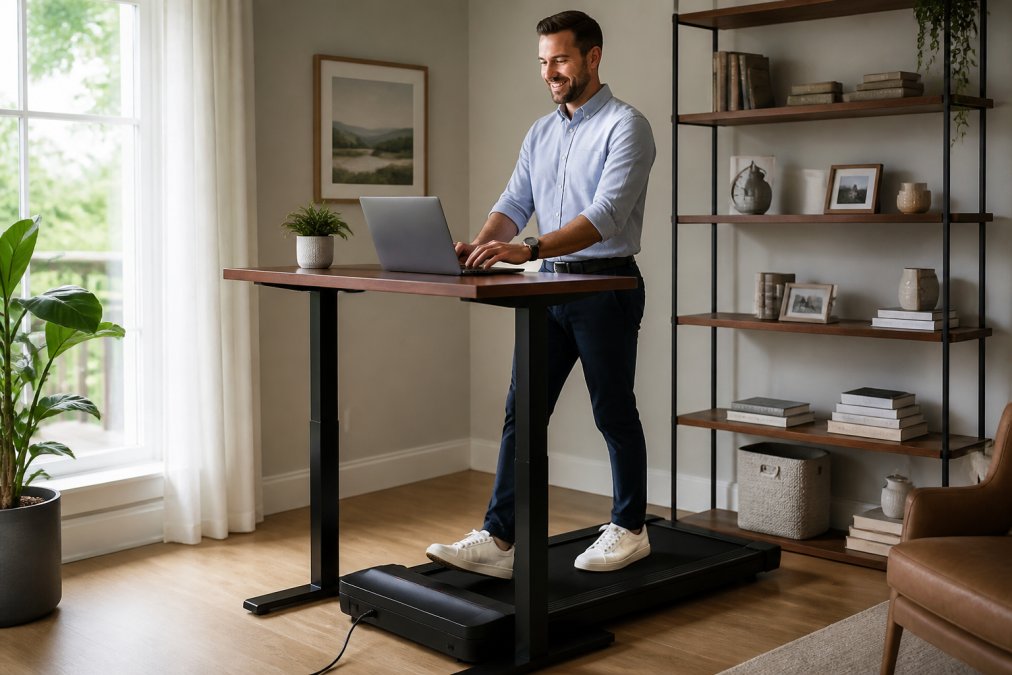
The key is matching your walking speed to your task. Save faster walking for phone calls or reading; use a slower pace for typing and detailed work. This approach also supports cardiovascular health without the sweat and recovery time of a gym workout, making it viable in professional attire. For workers who struggle with motivation, having the treadmill already set up removes the friction of "finding time" to exercise; the movement simply happens while you work.
Stretching and Posture Fixes You Can Do in Business Attire
You don't need a yoga mat or a change of clothes to address the physical toll of sitting. Desk-friendly stretches target the muscles that tighten most: hip flexors, chest, and neck. Stand and perform a standing hip flexor stretch by stepping one foot back and gently pressing your hips forward; hold for 20 seconds per side. For your chest and shoulders, clasp your hands behind your back and straighten your arms to open up the front of your body. These moves are subtle enough for a shared office and take under two minutes.
Posture is not about rigidly holding your spine in one position; it's about changing positions regularly. Set your chair so your feet rest flat and your knees sit at a 90-degree angle, then position your monitor at eye level to prevent neck strain. Alternate between sitting and standing every 30 to 45 minutes to distribute the load across different muscle groups. If you're wearing business attire, prioritize low-impact movements that don't crease your clothes or raise your heart rate too high; the goal is joint mobility and blood circulation, not a workout.
Common Mistakes to Avoid When Building Your Routine
Many workers abandon their movement routine within two weeks because they make avoidable errors. The first mistake is going too hard initially: jumping into hour-long walking sessions or aggressive stretching leads to soreness that derails consistency. Start with 10-minute walking sessions and two-minute stretch breaks, then gradually increase duration as your body adapts.
The second mistake is treating movement as a separate task rather than integrating it into existing workflows. If you wait for a "free moment" to exercise, it won't happen. Attach movement to habits you already have: walk during your lunch break, stretch after every meeting, or do calf raises while waiting for your coffee to brew. This approach builds an active lifestyle without requiring willpower.
The third mistake is ignoring ergonomic fundamentals while adding exercise. Walking on a treadmill with a poorly positioned monitor, or stretching while sitting in a chair that doesn't support your lower back, undermines your efforts. Fix your workspace first, then add movement. Research from the Mayo Clinic on the health risks of prolonged sitting indicates that breaking up sedentary time is important, but it works best alongside proper workstation setup.
| Mistake | Fix | Impact |
|---|---|---|
| Starting with intense sessions | Begin with 10-minute walks, 2-minute stretches | Prevents soreness, builds consistency |
| Waiting for free time to move | Attach movement to existing habits | Removes reliance on willpower |
| Adding exercise to a poor setup | Adjust monitor height and chair first | Prevents strain, maximizes benefit |
Your Next Step: Build a Routine You'll Actually Keep
The most effective routine to stay active desk job is the one you can maintain on your busiest days, not just your slow ones. Start by identifying two or three movement opportunities that fit naturally into your current schedule, whether that's a walking meeting, a stretch break after lunch, or a treadmill session during your morning email review. Write them into your calendar as recurring events so they become as non-negotiable as your team stand-up. Track your progress with an activity tracker or simple step log to see the cumulative effect of small daily changes. The cognitive benefits are equally compelling: regular movement improves focus and mental clarity, which makes you more productive, not less. If you're ready to add walking to your workday without leaving your desk, explore how a compact treadmill from Wild Bloom can help you reach your step goals with a quiet, space-saving design that requires no assembly.

Frequently Asked Questions
What is the 20-8-2 rule for desk workers?
The 20-8-2 rule is a simple daily movement framework: sit for 20 minutes, stand for 8 minutes, and walk for 2 minutes each hour. This cycle keeps your blood circulating and prevents stiffness without disrupting your workflow. Set a timer to remind you to switch positions. Over an 8-hour workday, this adds roughly 16 minutes of walking and 64 minutes of standing, which reduces the strain of prolonged sitting.
How can I stay active without leaving my desk?
You can stay active without leaving your desk by using a portable under desk treadmill like the Wild Bloom Walking Pad, which fits under most standing desks and operates below 45 dB so it won't disturb calls. Other options include seated leg lifts, chair squats, and desk push-ups. The key is consistency: aim for 5-10 minutes of walking or exercise every hour to maintain your energy and focus.
How many steps should I aim for while working a desk job?
A realistic goal for desk workers is 4,000 to 6,000 steps during the workday itself, which you can achieve with a walking treadmill and short movement breaks. This brings your total daily steps to 8,000-10,000 when combined with your commute and errands. Start with 1-2 miles per day at a slow pace of 1-2 mph. Gradually increase your speed and duration as your stamina improves.
What is the 5-5-5-30 rule for office workers?
The 5-5-5-30 rule is a daily movement plan: 5 minutes of stretching after waking, 5 minutes of mobility work before work, 5 minutes of walking every hour, and 30 minutes of moderate exercise after work. This structure makes movement a consistent part of your day. Many office workers find pairing the hourly 5-minute walks with a walking treadmill helps them stay consistent.
Building a sustainable movement routine while working a desk job comes down to strategy, not willpower. You need tools and habits that fit your environment and your schedule. Wild Bloom's portable under desk treadmill offers a practical way to increase your daily steps without disrupting your focus, with a quiet motor, foldable frame, and no-assembly setup that works in any home office. Get started with Wild Bloom and turn your workday into an opportunity for better health.