

Table of Contents
- Understanding Treadmill Noise: Impact vs. Airborne Sound
- Step 1: Choose the Right Location Away from Shared Walls
- Step 2: Select the Best Treadmill Mat for Apartment Noise
- Step 3: Install Treadmill Vibration Isolation Pads
- Step 4: Maintain Your Treadmill Belt for Quieter Operation
- Is a 35 dB Walking Pad Actually Quiet for Neighbors?
- Apartment Treadmill Etiquette and Neighbor Communication
- Conclusion
Last Updated: August 19, 2026
Understanding Treadmill Noise: Impact vs. Airborne Sound
Treadmill noise travels through your apartment in two distinct ways, and understanding the difference between them is essential to preventing treadmill noise for neighbors. Impact noise comes from the physical vibrations of the machine hitting the floor, the footfalls, the belt moving, the motor running. Airborne noise is the sound the treadmill emits into the air itself. Most people focus only on airborne noise (the hum of the motor), but impact noise is what actually bothers neighbors in units below or adjacent to yours.
This distinction matters because solutions that reduce one type of noise often do nothing for the other. A quiet motor helps with airborne noise, but it won't stop vibrations from traveling through floor joists and into your neighbor's ceiling. That's why a comprehensive approach requires addressing both types of sound transmission simultaneously.
At Wild Bloom, we've designed our walking treadmill with impact noise reduction in mind, our motor operates below 45 dB, which handles the airborne component. But the real challenge in apartment living is controlling structural vibration transmission, which requires additional steps beyond just buying a quiet machine. Below, we'll show you exactly how to prevent treadmill noise for neighbors using a combination of location strategy, equipment selection, maintenance, and communication.

Step 1: Choose the Right Location Away from Shared Walls
Your treadmill's location determines how effectively noise mitigation measures will work. Placing your treadmill against a shared wall or directly above a neighbor's bedroom is the single most common mistake apartment dwellers make. The structural vibration will transmit directly through the load-bearing wall or floor joists into adjacent units.
Instead, position your treadmill in the interior of your apartment, away from exterior walls and shared walls whenever possible. If your apartment layout forces you near a shared wall, place the treadmill perpendicular to it rather than parallel. This reduces direct vibration transmission through the structural framing.
Consider the time of day your neighbors are most likely to be home. If your neighbor works nights and sleeps during the day, morning workouts create maximum disturbance. Evening workouts might be more considerate. Communicate about your exercise schedule, many neighbor conflicts arise from surprise noise rather than the noise itself.
For apartments above ground level, remember that sound and vibration travel downward more efficiently than sideways. If you're on the second floor, your impact noise will be more noticeable to the unit below than to side neighbors. Ground-floor apartments have an advantage: vibration doesn't propagate downward into occupied space.
Step 2: Select the Best Treadmill Mat for Apartment Noise
A quality treadmill mat is your first line of defense against impact noise and vibration transmission. The mat acts as a resilient material layer between the treadmill and your floor, absorbing some of the mechanical noise before it reaches the structural floor joists.
Not all mats are created equal. Standard thin rubber mats (less than a quarter-inch thick) provide minimal vibration isolation. You need a mat that's at least half an inch thick, preferably three-quarters of an inch or thicker, made from dense rubber or a rubber-foam composite. The density matters more than the size, a smaller, denser mat will outperform a larger, flimsy one.
Look for mats specifically labeled for noise reduction or vibration dampening. These are engineered to absorb impact energy rather than simply cushion the treadmill. The best apartment treadmill mat for apartment noise will have a closed-cell foam core with a rubber exterior, which prevents vibration from traveling through the mat into the floor.
Placement is equally important. The mat should extend at least 12 inches beyond the treadmill footprint in all directions. This ensures that vibrations dissipate through the mat rather than traveling along the floor to adjacent areas. Secure the mat to prevent it from shifting during use, a moving mat loses its isolation effectiveness.
When selecting the best treadmill mat for apartment noise, avoid mats with a hard plastic bottom. These actually amplify vibration transmission because they create a rigid bridge between the treadmill and your floor. Soft rubber or foam bottoms are essential.
Step 3: Install Treadmill Vibration Isolation Pads
Vibration isolation pads sit directly under the treadmill's feet and provide a second layer of acoustic decoupling. While a quality mat handles broad vibration transmission, isolation pads address the concentrated force points where the treadmill contacts the floor.
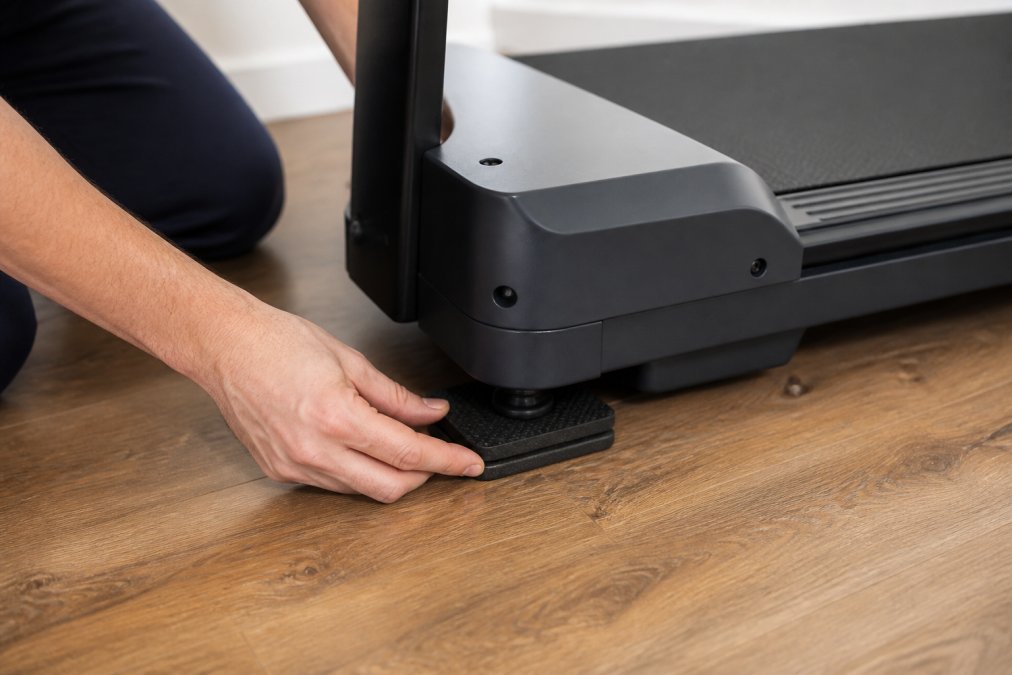
Isolation pads work by creating a flexible connection between the treadmill and the floor. As the treadmill operates, these pads absorb vibration energy and prevent it from transferring directly into the structural floor joists. The best isolation pads for treadmill vibration isolation are made from elastomer or high-density rubber compounds designed specifically for this purpose.
Install one isolation pad under each foot of the treadmill. If your treadmill has four feet, use four pads. For treadmills with a wider base, you may need six or eight pads distributed evenly across the footprint. The pads should be roughly the same height, uneven installation creates rocking and reduces isolation effectiveness.
When installing vibration isolation pads, ensure they're rated for the total weight of your treadmill plus your body weight during use. Undersized pads will compress too much and lose their isolation properties. Quality pads are typically rated for 200-400 pounds per pad.
Check that the pads don't interfere with the treadmill's built-in wheels or transport mechanism. Many apartment treadmills are designed to fold and move, so your isolation solution must allow for this. If your treadmill has wheels, you may need to remove the pads temporarily when moving the machine, then reinstall them in the new location.
Step 4: Maintain Your Treadmill Belt for Quieter Operation
A poorly maintained treadmill belt is a significant source of mechanical noise. Friction between a dry belt and the rollers creates squeaking and grinding sounds that travel through the floor structure. Regular maintenance directly reduces the noise your treadmill generates.
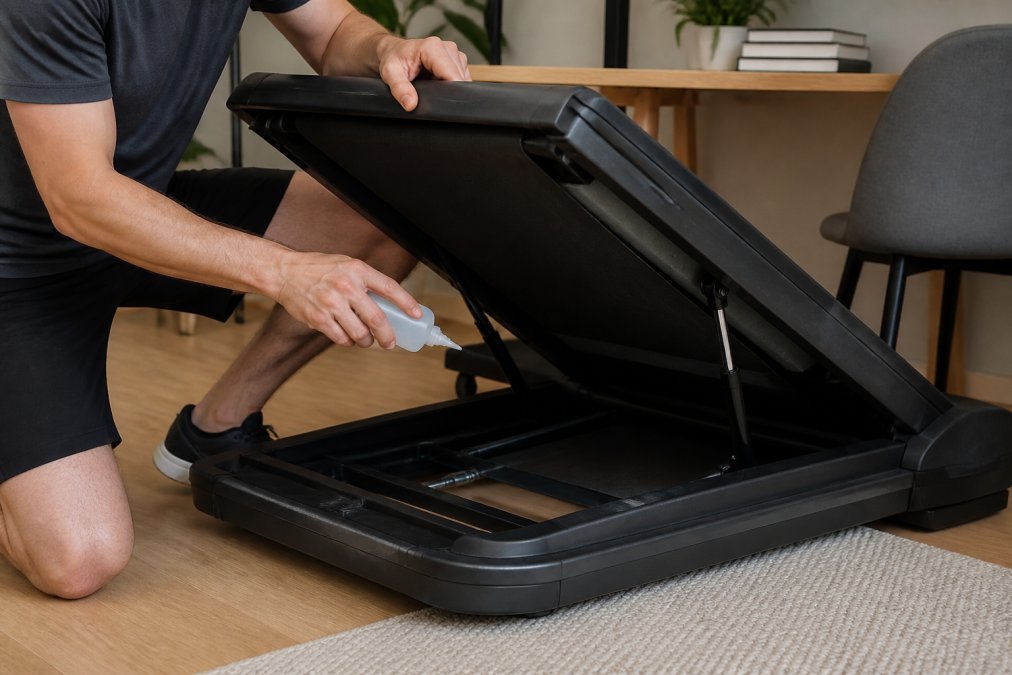
Check your treadmill's belt lubrication every 30 days of regular use. Most treadmill manufacturers recommend silicone-based belt lubricant applied to the underside of the belt. This reduces friction between the belt and the deck, which decreases both noise and wear on the belt itself.
To lubricate the belt, power off the treadmill and unplug it completely. Manually rotate the belt by hand to expose the underside. Apply lubricant along the entire length of the belt's underside, spacing applications about 6 inches apart. Then manually rotate the belt several more times to distribute the lubricant evenly. Allow it to sit for 5-10 minutes before plugging the treadmill back in.
Inspect the belt for signs of wear, fraying, or uneven wear patterns. A damaged belt creates vibration and noise that no isolation pad can fully absorb. If the belt shows significant wear, replacement is necessary, a new belt is quieter and safer than attempting to repair a damaged one.
Check the belt tension regularly. A belt that's too loose will slip on the rollers, creating squeaking and wasting energy. A belt that's too tight creates excessive friction and strain on the motor. Follow your treadmill's manual for proper tension adjustment, most modern treadmills have a simple tension screw that requires only a basic wrench.
The motor itself also requires attention. Dust accumulation inside the motor housing reduces efficiency and can cause audible grinding. Use a soft brush or compressed air to gently clean the motor vents every 60 days. Never use water or solvents near electrical components.
Is a 35 dB Walking Pad Actually Quiet for Neighbors?
A walking pad rated at 35 dB is genuinely quiet for the person using it, but whether it's quiet enough for neighbors depends on several factors. To understand this, you need to know what 35 dB actually sounds like and how sound travels through apartment structures.
For context, 35 dB is comparable to the sound level of a quiet library or a whispered conversation. It's roughly half the noise of a normal conversation (60 dB) and significantly quieter than a standard treadmill (75-80 dB). So yes, a 35 dB walking pad is substantially quieter than traditional exercise equipment.
However, the decibel level you see in product specifications is measured under controlled laboratory conditions, typically at a distance of 3-6 feet from the machine. In your apartment, the actual noise reaching your neighbor's ears depends on:
Distance from the source. The further your neighbor is from your treadmill, the less noise they perceive. A treadmill in your living room creates more disturbance in an adjacent unit than one in an interior bedroom.
Structural transmission. Even a quiet machine generates vibration. That 35 dB airborne noise is only part of the problem. The impact noise and structural vibration traveling through floor joists can be louder than the motor noise itself, especially to neighbors directly below you.
Neighbor sensitivity and schedule. A 35 dB sound during the day might be barely noticeable. The same sound at 6 a.m. when your neighbor is trying to sleep is far more disruptive. Sensitivity varies by individual, some people are highly aware of low-level background noise, while others tune it out.
Apartment construction quality. Older buildings with poor sound insulation between units transmit noise more readily than newer construction with acoustic barriers. A 35 dB machine in a well-insulated apartment might be inaudible to neighbors, while the same machine in a poorly insulated building could be noticeable.
The honest answer: a 35 dB walking pad is quiet enough for neighbors if you combine it with proper vibration isolation, location strategy, and maintenance. The decibel rating alone is not sufficient. Wild Bloom's walking treadmill operates below 45 dB, which is quieter than many standard walking pads, but the combination of the quiet motor plus isolation pads and proper placement is what actually prevents treadmill noise for neighbors.
Apartment Treadmill Etiquette and Neighbor Communication
The most effective noise prevention strategy is often the simplest: talk to your neighbors before you buy the treadmill. This direct communication prevents assumptions and resentment from building.
Tell your neighbors about your plans to use a treadmill for exercise. Explain that you're investing in noise reduction measures and ask about their schedule, when are they most sensitive to noise? When do they sleep, work from home, or have quiet time? A neighbor who knows you're being considerate and has had input into the timing is far more likely to be forgiving of occasional noise.
Establish a schedule that respects your neighbors' routines. If possible, exercise during times when neighbors are less likely to be home or when they expect activity noise. Weekday mornings before 7 a.m. and late evenings after 10 p.m. are typically inconsiderate times. Mid-morning or early evening workouts are usually acceptable in apartment buildings.
Offer to let neighbors test the noise level themselves. Invite them to your apartment while you're using the treadmill. Hearing the actual noise level is far more reassuring than worrying about an unknown problem. Many neighbor conflicts arise from anxiety about noise rather than the noise itself.
Be responsive if a neighbor does complain. Don't become defensive, take the complaint seriously and implement additional solutions. This might mean adjusting your exercise schedule, adding more isolation pads, or relocating the treadmill. A neighbor who sees you taking action is more likely to work with you rather than escalate the complaint to building management.
Document your noise reduction efforts. Keep receipts for isolation pads, mats, and maintenance supplies. If a building manager or landlord becomes involved, you can demonstrate that you've made reasonable efforts to prevent treadmill noise for neighbors. This protects you from potential lease violations or noise complaints.
Some apartments have explicit quiet hours in their lease. Review your lease carefully to understand what restrictions apply. Typically, quiet hours run from 10 p.m. to 7 a.m., but this varies by building. Operating your treadmill outside quiet hours and with proper isolation measures puts you well within acceptable bounds.
Preventing treadmill noise for neighbors requires a multi-layered approach: strategic placement away from shared walls, quality vibration isolation pads, a dense noise-reducing mat, regular belt maintenance, and honest communication with the people sharing your building. A quiet treadmill like Wild Bloom's walking pad (below 45 dB) is an excellent foundation, but the isolation measures and maintenance matter just as much as the equipment itself. By combining all these strategies, you can maintain a consistent fitness routine without creating conflict in your living space. The investment in proper noise prevention is small compared to the benefit of guilt-free exercise and peaceful relationships with your neighbors.
Frequently Asked Questions
Can a downstairs neighbor hear a walking pad through the floor?
Yes, they can hear vibration transmission and impact noise if your treadmill sits directly on a floor without isolation. Sound travels through structural elements like floor joists. Using isolation pads, a quality mat, and proper positioning away from shared walls significantly reduces what neighbors hear. A quiet motor below 45 dB helps, but vibration isolation is equally important as motor noise reduction.
Do treadmill mats actually reduce noise for neighbors?
Quality mats absorb impact noise and dampen vibrations, but effectiveness depends on thickness and material. Rubber or foam mats at least 0.5 inches thick provide meaningful noise reduction. For maximum neighbor protection, combine a mat with vibration isolation pads underneath, this acoustic sandwich approach addresses both impact noise and structural vibration transmission far better than a mat alone.
What does 45 dB actually sound like compared to a regular treadmill?
A 45 dB motor is roughly as loud as a quiet conversation or office background noise. Traditional treadmills run 70-80 dB. However, total treadmill noise includes motor sound plus vibration and impact noise. A quiet 45 dB motor combined with isolation pads and proper matting creates a significantly quieter experience than a standard treadmill, though structural vibration transmission can still be noticeable without isolation measures.
When should I talk to my neighbors about my treadmill use?
Communicate before you start regular use, especially in apartments. Mention your equipment, expected usage times, and noise-reduction measures you've taken. Ask about their schedule and preferred quiet hours. Most neighbors appreciate the heads-up and are understanding if you've invested in noise control. This conversation prevents complaints and builds goodwill, critical for apartment treadmill etiquette.
This article was written using GrandRanker