

Table of Contents
- The Real Cost-Benefit Breakdown of Walking Desks
- Benefits of Under Desk Treadmills for Your Health and Productivity
- How to Increase Daily Step Count Without Disrupting Your Workflow
- How Long to Use a Walking Pad for Sustainable Results
- Pricing, Setup, and Space: What You Actually Need to Know
- Common Misconceptions About Walking Desks
- Is It Worth It? Making Your Decision
Last Updated: August 22, 2026
The Real Cost-Benefit Breakdown of Walking Desks
A walking desk isn't just another piece of office equipment, it's a decision about how you want to spend eight hours of your day. The question of whether a walking desk is worth the price requires looking at what you're actually paying for and what you'll actually get in return.
The core tension here is simple: walking desks cost more than traditional desks, but they also deliver benefits that standard furniture can't. The real question isn't whether they work. It's whether the specific benefits they deliver matter enough to your life to justify the investment.
Wild Bloom's portable under desk treadmill sits at the entry point of this market, $149.99 for a compact, foldable unit designed specifically for people working from home or in tight office spaces. That's significantly less than full-size treadmill desks, which can run $800 to $2,000. But even at this price point, you need to know what problem you're actually solving before you buy.

The walking desk worth the price question breaks down into three parts: the health benefits, the productivity impact, and the practical reality of actually using it. Most people focus on the first two and ignore the third. That's where the real cost-benefit analysis falls apart.
Benefits of Under Desk Treadmills for Your Health and Productivity
Under desk treadmills address a specific problem that's become increasingly urgent: sedentary lifestyle damage from prolonged sitting. Eight hours at a desk every day compounds. Your joints stiffen, your cardiovascular system weakens, and your metabolic rate slows. An under desk treadmill interrupts that pattern.
The health benefits are real, though not new. Walking at 2 to 3 miles per hour while working burns more calories than sitting completely still (peer-reviewed research). It improves circulation and reduces the blood sugar spikes that come from long periods of inactivity. Your joints stay mobile. Your back doesn't lock up at the end of the day.
But here's what most guides miss: these benefits only materialize if you actually use the equipment. That's where many people stumble. A walking pad collecting dust in your closet delivers zero health benefits. The equipment only works if it fits into your actual workflow, not just your ideal workflow.
The productivity angle is where walking desks get interesting. Many people assume that moving while working will distract them. The opposite often happens. Light movement, the kind you get from a slow walk, can actually improve focus for certain types of work. Your brain gets more oxygen. You're less likely to zone out into that mid-afternoon fog.
This works best for tasks that don't require intense fine motor control. Email, messaging, reading, and strategic thinking all work fine on a walking pad. Video calls work too, though we'll address the noise concern separately. Tasks requiring precise typing or detailed design work are harder, not impossible, but harder.
The real productivity benefit isn't that you work faster. It's that you work more consistently. You don't hit that 2 p.m. wall where you feel like your body is shutting down. You have more energy at 5 p.m. than you would have sitting still.
How to Increase Daily Step Count Without Disrupting Your Workflow
This is where the walking desk worth the price decision becomes practical. How much do you actually need to increase your daily step count, and how much disruption can you tolerate?
A sedentary desk job typically means 3,000 to 5,000 steps per day (the CDC). Health guidance suggests aiming for 7,000 to 10,000 (the CDC). A walking pad running at 2 miles per hour for two hours adds roughly 4,000 steps. That's the difference between sedentary and healthy, right there.
But you don't need to walk for two solid hours. Many people find that breaking walking into 20 to 30-minute sessions throughout the day works better. Walk during your first meeting of the day, step off during lunch, walk again mid-afternoon. You've hit your step goal without dedicating one continuous block of time.
The key is matching the walking pace to your actual work. Slower is better, 1.5 to 2.5 miles per hour. Fast enough to elevate your heart rate slightly and keep your legs engaged, but slow enough that you can type, think, and communicate without losing balance or accuracy.
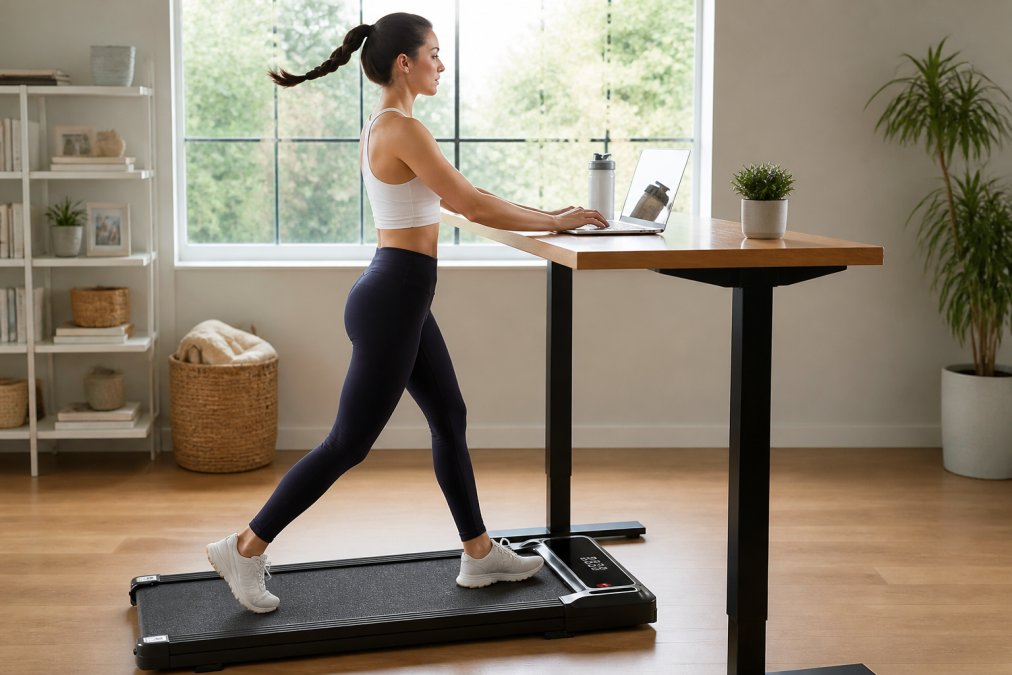
This is where the Wild Bloom design matters. The quiet motor below 45 dB means you can walk during video calls without creating background noise that disrupts your colleagues. The shock-absorbing belt reduces the physical jarring that can throw off your typing. The no-assembly design means you're not spending two hours on setup before you even get to try it.
Many people ask whether they can maintain this consistently. The answer depends on your work type and your actual commitment. If your job involves back-to-back video calls, a walking pad works in the gaps. If you spend most of your day in deep work that requires intense focus, walking during that time will feel unnatural. Match the equipment to your actual schedule, not your aspirational schedule.
How Long to Use a Walking Pad for Sustainable Results
Here's the mistake most people make: they buy a walking pad and try to use it for six hours straight on day one. By day three, their feet hurt, their knees ache, and they're convinced the equipment is garbage. The problem isn't the equipment. It's the progression.
Your body needs time to adapt to walking while working. Start with 20 to 30 minutes per day for the first week. Your feet aren't used to the belt. Your calves aren't used to the continuous engagement. Your brain isn't used to coordinating walking and typing simultaneously. Give it time.
Week two, increase to 45 minutes to an hour. By week three or four, you can comfortably handle two hours spread across your day. Some people eventually work up to four hours, but that's not necessary for the health benefits to kick in.
The sustainable sweet spot for most people is 90 minutes to two hours per day, broken into multiple sessions. That's enough to interrupt sedentary patterns and increase your daily step count significantly. It's not so much that you're fighting physical fatigue or experiencing joint strain.
The quality of the walking pad matters here. A cheap belt that doesn't absorb shock will wear down your knees. A loud motor will make you avoid using it during calls. A walking pad that requires assembly before you can use it creates friction that kills consistency. Wild Bloom's design, the shock-absorbing belt, the quiet motor, the no-assembly setup, removes these friction points. You can literally unbox it and start walking.
Pricing, Setup, and Space: What You Actually Need to Know
Let's talk about the actual cost-benefit analysis. Wild Bloom's portable under desk treadmill is $149.99. That's your entry point. Compare that to a traditional standing desk, which runs $400 to $1,200, or a full-size treadmill desk, which runs $800 to $2,000.
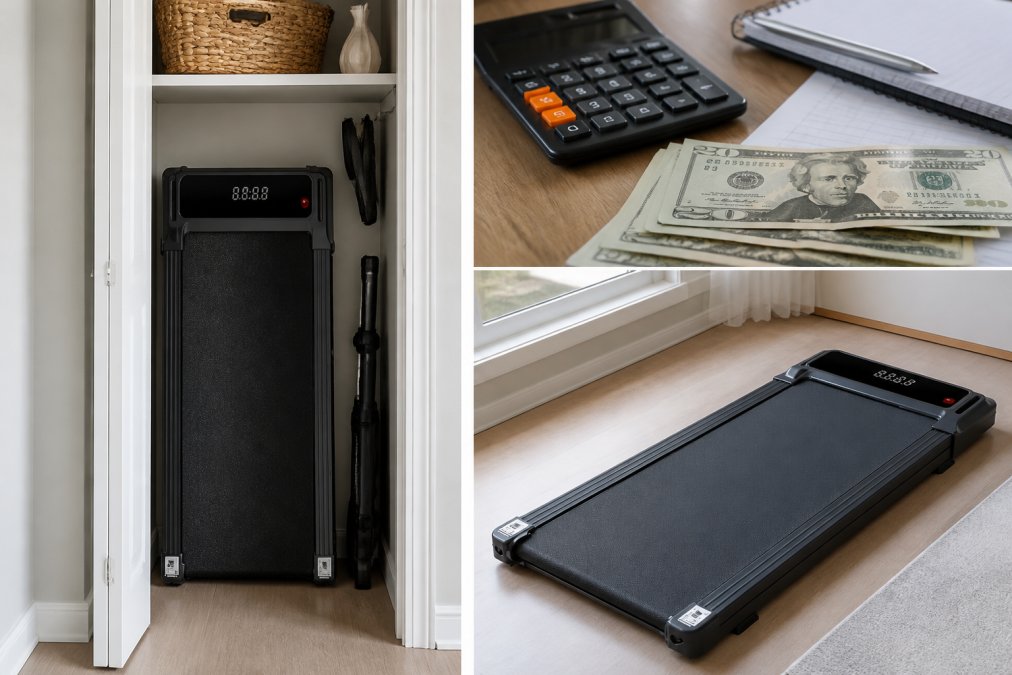
But price alone doesn't tell you whether it's worth the investment. You need to know what you're getting for that money and whether it actually fits your life.
The Wild Bloom unit is designed for people in tight spaces. It folds for storage. It has built-in transport wheels so you can move it easily. The no-assembly design means you're not spending an hour with an Allen wrench before you can use it. These features matter more than you'd think if you live in an apartment or have a small home office.
Space requirements are real. You need at least 5 to 6 feet of linear space in front of your desk to walk safely. If your desk is against a wall or wedged into a corner, a walking pad won't work. If you have a standard desk setup with clear space in front, you're fine. Measure your space before you buy. This is non-negotiable.
Setup takes about five minutes: unbox it, place it under your desk, plug it in, adjust the speed with the remote control. That's it. No assembly. No calibration. No software to install. This is the opposite of the typical fitness equipment experience where you spend hours setting up and then realize you need a software update before you can use it.
The real cost consideration is durability. A walking pad that lasts three years at $150 costs $50 per year. One that lasts six years costs $25 per year. One that breaks after eight months is expensive. The Wild Bloom design, the anti-slip belt, the shock absorption, the quiet motor, is built for longevity. That's what you're paying for when you choose a quality unit over the cheapest option available.
Common Misconceptions About Walking Desks
The first misconception is that walking desks are for fitness. They're not. They're for movement. The calorie burn from walking at 2 miles per hour is modest, maybe 200 to 300 calories per hour depending on your body weight. That's not a workout. That's interrupting sedentary time. If you want to get fit, you need actual exercise. A walking pad is about NEAT, non-exercise activity thermogenesis, which is the movement you do during normal life.
The second misconception is that you can walk and do everything. You can't. Complex typing, detailed design work, video production, or anything requiring intense fine motor control becomes difficult. Walking and email? Fine. Walking and coding? Harder. Walking and spreadsheet work? Depends on the complexity. Know your limits.
The third misconception is that a walking pad is quieter than a regular treadmill, so it won't bother anyone. Below 45 dB is quiet for a motorized device. It's quieter than normal conversation. But it's not silent. If you have thin walls or live in an apartment where sound travels, your neighbors will hear it. This isn't a Wild Bloom problem, it's a physics problem. Any motorized equipment makes noise. Plan accordingly.
The fourth misconception is that you'll use it consistently. You might not. Equipment adoption is hard. The walking pad that seemed essential on day one might sit unused by month three. This is why the no-assembly design and easy storage matter. If you can set it up in 30 seconds and fold it away just as fast, you're more likely to use it sporadically. If setup is a 30-minute ordeal, you'll avoid it.
The fifth misconception is that walking desks are a replacement for actual exercise. They're not. They're a supplement to a healthy lifestyle, not a substitute for it. If you're not exercising otherwise, a walking pad won't fix that. It will interrupt sedentary time, which is valuable. But it's not the same as cardiovascular exercise or strength training.
Is It Worth It? Making Your Decision
The walking desk worth the price comes down to three questions. First: Do you actually have the space? If your desk setup doesn't allow for clear floor space in front of you, stop here. A walking pad won't work. Second: Does your work allow for walking? If you spend your day in video calls or doing work that requires precise hand-eye coordination, a walking pad works in the gaps but not during your main work. That's fine, it's still valuable. Third: Will you actually use it?
This last question is the hardest to answer honestly. Many people buy fitness equipment with the best intentions and never use it. The difference with a walking pad is that it's cheap enough that you can afford to be wrong. $150 is a reasonable bet on whether you'll actually increase your daily movement. $1,500 is not.
If you answer yes to all three questions, a walking desk is worth the price. It's not because it's magical. It's because it solves a real problem, sedentary lifestyle damage, in a way that fits into your existing work. You don't have to choose between productivity and movement. You get both.
Wild Bloom's portable under desk treadmill is the entry point for this decision. At $149.99, it's priced for experimentation. The no-assembly design removes friction. The quiet motor keeps you from disrupting your colleagues. The foldable design means it doesn't dominate your space when you're not using it. The shock-absorbing belt protects your joints.
The real cost-benefit analysis isn't about the equipment. It's about your life. If you're spending eight hours a day at a desk and feeling the physical consequences, a walking pad is worth the investment. If you're already active and just looking for marginal gains, you might get more value from other changes. Be honest about which category you're in, and the decision becomes clear.
The walking desk worth the price question has a simple answer: it depends on your space, your work, and your honesty about whether you'll use it. Wild Bloom's portable under desk treadmill removes the barriers to trying, no assembly, quiet operation, compact storage, and an affordable entry price. Start with 20 to 30 minutes daily and increase gradually as your body adapts. If you stick with it for a month, you'll know whether increased daily step count and interrupted sedentary time matter to your health and focus. That's the only way to answer this question for yourself. Get started with Wild Bloom and discover whether movement while working is the missing piece in your daily routine.
Frequently Asked Questions
What are the main drawbacks of using a walking desk?
The biggest challenge is balancing movement with focus during detailed work. Some users experience initial fatigue in their legs and feet, and the investment, typically $150 to $800 depending on features, requires commitment to see a return. Noise can be an issue in shared spaces, though quiet motors (below 45 dB) minimize this. Not everyone maintains consistent use after the first few months, so realistic expectations about your schedule matter.
How long should you use a walking pad each day to see health benefits?
Start with 20-30 minutes per day and gradually increase as your body adapts. Research suggests that even 30 minutes of daily walking supports cardiovascular health and can help counter the effects of prolonged sitting. The key is consistency rather than duration. Many professionals split their walking into two or three shorter sessions throughout the day to avoid fatigue while maintaining productivity and increasing their daily step count.
Can a walking desk actually help me be more productive?
Yes, but with caveats. Light walking (1-2 mph) supports focus and can reduce afternoon energy dips. However, faster speeds or complex typing tasks can create a conflict. The productivity boost comes from improved blood flow and mental clarity, not from multitasking. Users report better focus during emails, calls, and creative thinking, but reserve seated work for tasks requiring intense concentration or fine motor control.
Will a walking desk fit in my small apartment or tight office space?
Compact, foldable models like the Wild Bloom portable under desk treadmill ($149.99) are designed for tight spaces. When folded, they measure roughly 30 by 15 inches and can fit under a bed, in a closet, or behind a door. Measure your desk height (typically 28-30 inches) and available floor space before purchasing. The trade-off is that compact models have a shorter belt and lower maximum speed, but they suit apartment dwellers and remote workers perfectly.
This article was written using GrandRanker