

Table of Contents
- Why Walking Pad Alternatives Matter for Apartment Living
- Best Treadmill for Small Apartment Living
- Under Desk Treadmill Noise Levels: What You Need to Know
- Non-Treadmill Alternatives That Save Space
- How to Store a Walking Treadmill in Limited Space
- Comparing Space, Cost, and Long-Term Durability
- Conclusion
Last Updated: August 28, 2026
Why Walking Pad Alternatives Matter for Apartment Living
If you work from home in a small apartment, you know the constraint: there's barely room for your desk, let alone a full treadmill. Yet sedentary work kills productivity and health. A walking pad alternative for small spaces needs to solve three problems at once: occupy minimal footprint, operate quietly enough for video calls, and integrate seamlessly into an already-packed room. This guide explores the full spectrum of solutions, from compact treadmills to non-treadmill alternatives most guides ignore.
Best Treadmill for Small Apartment Living
A compact treadmill designed for apartments prioritizes footprint over features. The best treadmill for small apartment living folds vertically or horizontally, operates quietly, and moves easily between storage and your work area.
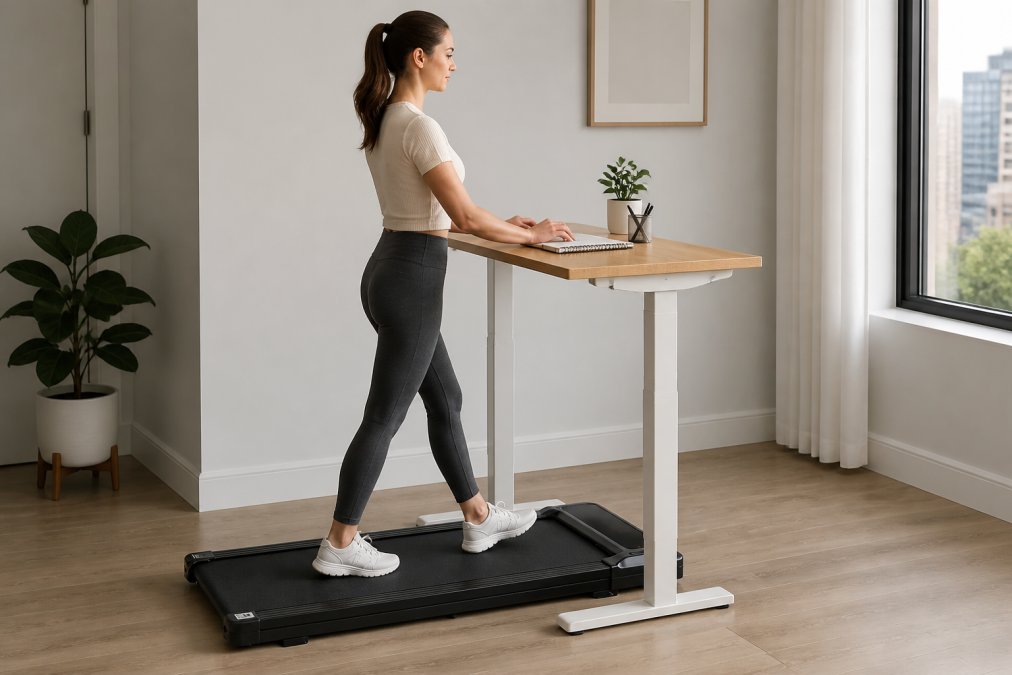
The Wild Bloom portable under desk treadmill exemplifies this approach. Its no-assembly design means you unbox it and start walking. The built-in transport wheels let you move it from closet to desk in seconds, and the foldable design compresses to a footprint smaller than most office chairs when stored. At under 45 dB, the motor runs quiet enough for back-to-back video calls without clients hearing background noise.

What sets this treadmill apart for apartment living is the anti-slip belt with shock absorption. Walking on hard floors for hours creates joint stress; the cushioning reduces impact on knees and ankles while the grip prevents slipping when reaching for your keyboard. For apartments where every inch matters, storage footprint and noise performance matter more than weight capacity or maximum speed.
Under Desk Treadmill Noise Levels: What You Need to Know
Below 45 dB is the threshold where most people can't hear the motor during normal conversation, quieter than a refrigerator and roughly equivalent to a quiet library (the CDC). The motor is the primary sound source, though footfall impact also matters. A low-noise motor running at steady speed generates less disturbance than the rhythmic thud of footsteps on the belt itself. Shock absorption in the walking surface reduces that impact noise significantly.
When evaluating under desk treadmill noise levels, test the motor at maximum speed. A well-designed motor maintains consistent RPMs with a low hum, while a laboring motor creates high-pitched whining. A properly lubricated belt runs quieter than one with friction. For video call compatibility, below 45 dB is genuinely sufficient; a quiet motor running beneath your desk won't register as background noise to your clients.
Non-Treadmill Alternatives That Save Space
Not every apartment dweller needs or wants a treadmill. For users with zero floor space or those seeking silent operation, non-treadmill alternatives deliver genuine movement without equipment footprint.
Under-Desk Ellipticals and Pedal Machines
Under-desk ellipticals occupy 18-24 inches of floor space when in use and collapse to 12 inches when stored. Unlike treadmills, they operate completely silently because there's no motor. The trade-off is that seated pedaling doesn't replicate walking's natural gait and burns fewer calories per hour than treadmill walking. For users in shared walls or with noise-sensitive neighbors, silent operation is decisive. Pedal machines are ideal for low-impact leg endurance during long desk sessions.
Desk Cycles
Desk cycles are the most compact option, typically 12-18 inches wide and weighing under 20 pounds. They mount directly under your desk and let you pedal while typing. Like ellipticals, they're silent and require no motor maintenance. The limitation is that pedaling engages only the lower body and doesn't provide the cardiovascular intensity of walking. Users with limited mobility or joint issues often prefer desk cycles because the seated, supported position reduces strain.
Balance Boards and Standing Alternatives
A balance board placed under a standing desk forces your core and stabilizer muscles to engage while you work. It occupies zero additional floor space and costs $30-$80. The downside is that balancing for eight hours is fatiguing and doesn't provide the step count or cardiovascular benefit of walking. Standing desk converters raise your existing desk surface without adding equipment; they solve the sedentary position problem but don't add movement.
When to Choose Non-Treadmill Over Treadmill
Choose an under-desk elliptical or pedal machine if: (1) noise is your primary constraint and you have neighbors sharing walls, (2) you have zero floor space and can't store a folded treadmill, or (3) you prefer seated movement and accept lower step counts. Choose a treadmill if you want to replicate natural walking, maximize daily step count, and have even minimal closet or corner storage.
How to Store a Walking Treadmill in Limited Space
Vertical storage saves floor space. A foldable walking treadmill stored upright in a closet occupies roughly the footprint of a standard door. Lean it against the back wall, and it takes up no functional closet space, just height.
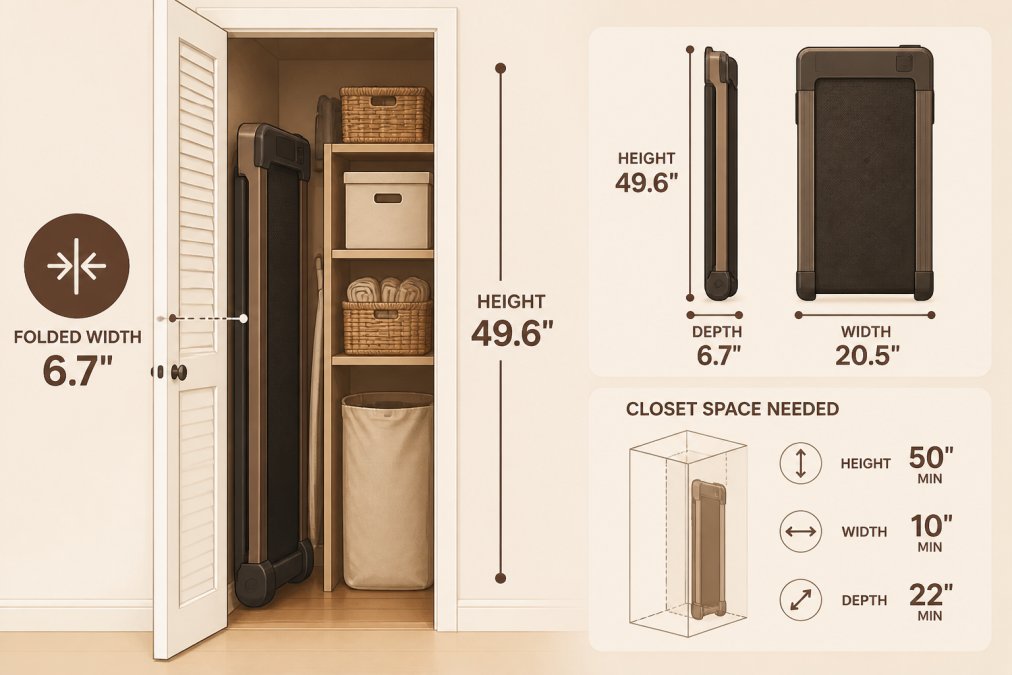
Horizontal storage under a bed works for low-profile models if clearance exists. A simpler approach is a rolling cart: place the folded treadmill on a wheeled cart and tuck it in a corner or behind a door. Built-in transport wheels are essential for apartment storage; without them, moving a treadmill is a two-person job. The key is making storage so easy that you don't avoid using the treadmill because moving it feels like a chore.
Comparing Space, Cost, and Long-Term Durability
| Option | Footprint (Folded) | Noise Level | Durability | Best For |
|---|---|---|---|---|
| Compact folding treadmill | 24-36 inches wide | Below 45 dB | 3-5 years typical | Daily desk work integration |
| Standing desk converter | 0 (desk-based) | Silent | 5+ years | Intermittent standing breaks |
| Under-desk elliptical | 18-24 inches | Silent | 2-4 years | Low-impact pedaling while seated |
| Desk cycle | 12-18 inches | Silent | 2-3 years | Stationary cardio while working |
Real-World Storage Measurements
Manufacturer specs often omit critical dimensions that matter in tight apartments. A folding treadmill listed as "24 inches wide" when folded doesn't account for the power cord (typically 6-8 feet), which must be stored separately. Measure your closet depth, width, and height before purchasing. Check whether the folded height (typically 48-52 inches for compact models) fits your closet's vertical clearance. If storing under a bed, measure the clearance with the bed frame in place; most treadmills are 6-8 inches thick when folded.
Cost and Value Over Time
Budget folding treadmills start at $99.99-$149.99 and typically last 2-3 years with daily use. Mid-range models ($300-$600) often reach 4-5 years because they use higher-quality motors and belts. For apartment dwellers testing whether a treadmill fits their workflow, a budget model is a reasonable entry point.
Maintenance and Repairability
Durability depends far more on maintenance than on initial quality. The walking belt requires lubrication every 3-6 months depending on use frequency (the CDC). Most treadmills include silicone lubricant; apply it to the underside of the belt while the motor is off, then run the treadmill at low speed for 2-3 minutes to distribute it evenly. Motor burnout occurs when the belt isn't lubricated or when the treadmill is used continuously for hours without breaks (peer-reviewed research). Most motors are rated for 1-2 hours of continuous use; taking a 10-minute break every hour extends motor life significantly.
Belt replacement costs $80-$200 depending on the model. Check whether replacement belts are available through the manufacturer before purchasing. Mid-range and premium brands typically stock parts for 5+ years. This is the single most important durability factor: a $150 treadmill with available $100 replacement belts is more durable long-term than a $400 model with proprietary parts that cost $250 to replace.
Ergonomic Integration and Posture
Walking on a treadmill while typing requires your monitor to be at eye level and your keyboard at elbow height. If your monitor is too high or too low, you'll compensate with poor posture, which increases fatigue and reduces consistency. Invest in a monitor arm ($40-$100) that lets you raise your screen to eye level while walking. This single adjustment dramatically increases the likelihood you'll use the treadmill consistently.
Conclusion
Walking pad alternatives for small spaces come down to one decision: do you want a treadmill that folds and stores easily, or do you want something different entirely? For apartment dwellers working at desks, a compact folding treadmill wins because it solves the core problem, sedentary work, without requiring permanent floor space.
Wild Bloom's portable under desk treadmill delivers the essentials: no assembly, quiet operation below 45 dB, built-in wheels for easy storage, and anti-slip shock-absorbing belt for safe, comfortable walking during work. At $149.99, it's an accessible entry point for professionals ready to integrate movement into their day. Get started with Wild Bloom and increase your daily steps without disrupting your focus or your neighbors.
Frequently Asked Questions
What can you use instead of a walking pad?
Walking pad alternatives for small spaces include resistance bands, step platforms, stationary bikes, rowing machines, and balance boards. Many professionals also use desk cycles or mini steppers that fit under desks. For those seeking low-impact movement, standing desks combined with short walking breaks throughout the day offer a practical solution. The best choice depends on your available space, fitness goals, and noise tolerance in shared living environments.
How much noise does an under desk treadmill actually make?
Quality under desk treadmills operate at 40-50 dB, comparable to a quiet office environment or refrigerator hum. This noise level is significantly quieter than traditional treadmills, which typically range from 75-85 dB. Models with low-noise motors below 45 dB are suitable for video calls and shared apartments. However, belt friction and motor vibration can still transmit through flooring, so placement on a mat helps minimize sound transfer to neighbors below.
How do I know if a walking treadmill will fit my apartment?
Measure your intended storage location first. Most compact walking treadmills fold to approximately 28-32 inches long, 24-28 inches wide, and 4-5 inches thick when stored. Check doorway widths and hallway clearances before purchasing. Consider vertical storage options like closets or behind doors, which maximize space efficiency. The Wild Bloom portable under desk treadmill includes built-in transport wheels, making it easy to move and reposition as needed in tight quarters.
Will a walking pad actually help me stay active if I work from home?
Studies show that movement breaks improve focus and productivity while reducing sedentary time. Walking pad users report increased daily step counts and improved energy levels during work hours. However, consistency depends on setup convenience and comfort. Models with no-assembly design and quiet motors remove friction points that cause equipment abandonment. Pairing a walking pad with specific step goals and placing it in your primary work area increases the likelihood of regular use.
This article was written using GrandRanker