

Table of Contents
- Walking Treadmill vs Standing Desk Converter: Key Differences
- Health Benefits of Standing vs Walking
- Benefits of Walking While Working
- Best Treadmill for Small Apartment Living
- Ergonomic Workspace Best Practices
- Productivity, Noise, and Long-Term Sustainability
- Which Option Is Right for You?
Last Updated: August 30, 2026
Walking Treadmill vs Standing Desk Converter: Key Differences
Choosing between a walking treadmill and a standing desk converter comes down to understanding what each option actually delivers, and what it doesn't. Both claim to combat sedentary lifestyle challenges, but they solve different problems in fundamentally different ways.
A walking treadmill is a motorized device that allows you to walk at a slow pace (typically 0.5 to 4 mph) while working. A standing desk converter, by contrast, simply raises your work surface to allow standing instead of sitting. The walking treadmill adds movement and caloric expenditure to your workday. The standing desk converter eliminates sitting but doesn't guarantee any additional activity beyond what you'd do standing still.
The gap between these two approaches matters more than most people realize. Standing is better than sitting. Walking is better than standing. But each option carries trade-offs in noise, stability, space requirements, and long-term sustainability that directly affect whether you'll actually use it consistently.
At Wild Bloom, we've spent considerable time helping remote professionals navigate this exact decision. The professionals we work with aren't looking for a gym replacement, they're looking for a way to integrate more movement into an 8-hour workday without sacrificing focus or productivity. That distinction shapes everything about which solution makes sense for your specific situation.

Health Benefits of Standing vs Walking
Standing burns more calories than sitting, but the difference is modest. The metabolic rate increase from standing is roughly 7-10% higher than sitting for the same duration, meaningful over a full year, but not transformative in a single day (peer-reviewed research).
Walking changes the equation entirely. Sustained walking at even 2 mph increases caloric expenditure significantly compared to standing. More importantly, walking engages your cardiovascular system, improves blood circulation, and activates larger muscle groups throughout your legs and core. Standing keeps you stationary; walking creates actual movement.
The real health advantage of walking goes beyond calories. Regular movement throughout the day improves musculoskeletal health by preventing the stiffness and postural strain that comes from prolonged static positions, whether sitting or standing. Walking also supports better joint health by maintaining mobility and preventing the kind of joint impact damage that can accumulate from years of sedentary work.
Standing alone doesn't solve the core problem of a sedentary lifestyle. You're still motionless for 8 hours, just vertically instead of horizontally. Walking addresses the actual issue: lack of movement and activity.
That said, standing is a legitimate stepping stone. If you're currently sitting all day, switching to a standing desk converter is a clear improvement. The psychological shift matters too, you feel more alert and engaged when standing. But if your goal is measurable health improvement, walking delivers results that standing simply cannot match.
Benefits of Walking While Working
Walking while working maintains your productivity while adding movement to your day. This is the counterintuitive part that stops most people from trying it: you can actually focus and work effectively on a slow-moving treadmill.
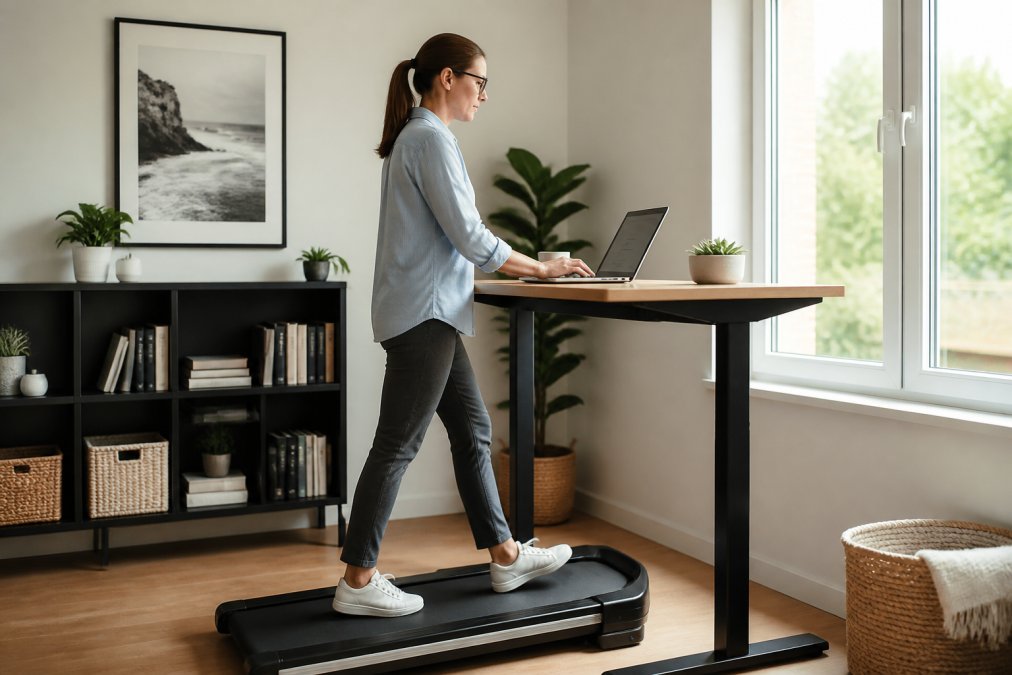
The key is speed. A walking treadmill isn't a running treadmill. You're moving at 1-3 mph, slow enough that your hands stay steady for typing, your eyes stay focused on your screen, and your breathing remains normal. After a brief adjustment period (usually 3-5 days), most people find they can work normally while walking (peer-reviewed research). Some report feeling more alert and focused than when sitting.
Non-exercise activity thermogenesis (NEAT) is the technical term for calories burned through everyday movement. Walking while working dramatically increases your NEAT compared to sitting. Over a full workday, this compounds: if you walk for 6 hours at 2 mph, you're burning significantly more calories than you would sitting, without the time cost of a separate workout.
The psychological impact of multitasking while walking is worth noting. Some people feel energized by the combination, their mind feels sharper, their mood improves, and they report less afternoon fatigue. Others find it cognitively demanding at first. The adjustment period matters. Most users report that within a week, walking becomes automatic, and they stop thinking about the physical act entirely.
A common mistake is trying to work on tasks that require intense focus or frequent mouse movement when you first start. Email, writing, and video calls work fine. Complex spreadsheet work or design tasks are harder initially. Start with your most routine work while walking, then gradually expand to more demanding tasks as your body adapts.
The stability concern is real but manageable. A quality walking treadmill with a stable, non-slip belt and proper desk height adjustment eliminates most balance issues. Your keyboard and mouse need to be positioned at the right height, slightly lower than a traditional standing desk, so your arms aren't reaching or overextending. This ergonomic adjustment is essential.
Best Treadmill for Small Apartment Living
Space is the practical constraint that makes or breaks a walking treadmill in a small apartment. A full-size treadmill takes up 6-7 feet of length and 3 feet of width. That's not happening in most apartment home offices.
An under-desk walking treadmill solves this problem entirely. These compact units fit beneath your existing desk, measure roughly 4-5 feet in length and 2 feet in width, and can be folded or stored upright when not in use. The Wild Bloom portable under desk treadmill, for example, folds down to a footprint small enough to slide into a closet or stand vertically in a corner.
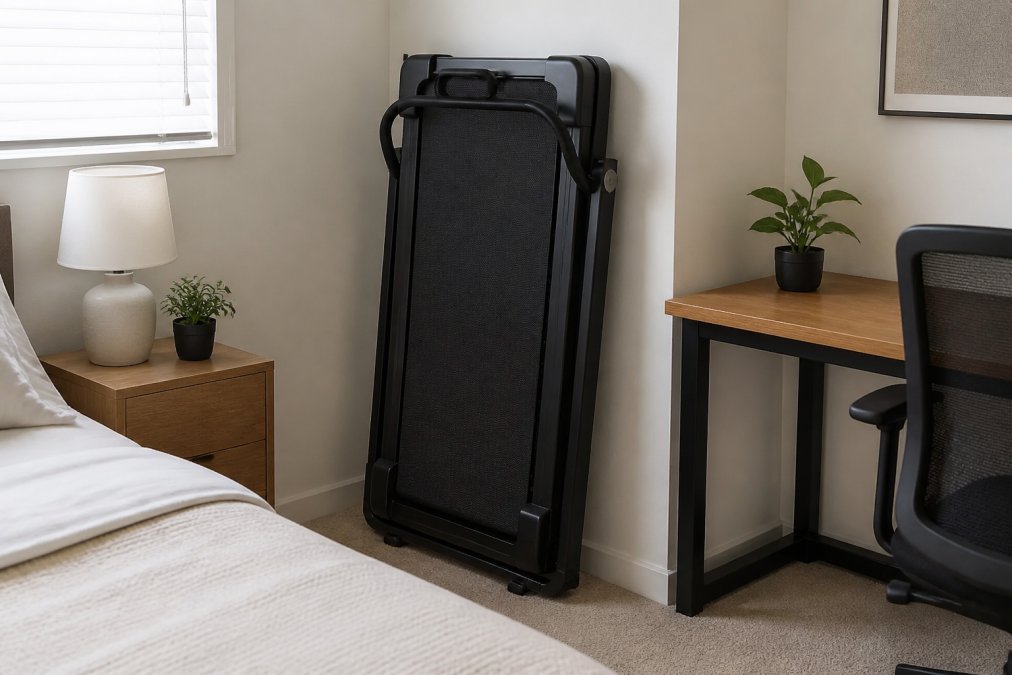
The no-assembly design matters more than it sounds. You unbox it, plug it in, and it's ready to use. No tools, no frustration, no two-hour setup process that kills your motivation before you even start. In a small apartment where space is already tight, assembly friction is a real barrier.
Weight and portability are secondary concerns in apartments, but they matter. A portable treadmill with built-in transport wheels can be moved between rooms or stored easily. If you ever move, which apartment dwellers do frequently, you don't want a 200-pound anchor you can't relocate.
The motor noise is critical in shared housing. A standard treadmill runs at 70-80 decibels. Your neighbors will hear it. A quiet motor operating below 45 dB, like the Wild Bloom unit, is barely noticeable. This isn't a luxury; it's the difference between being able to use the equipment consistently and having complaints from neighbors after the first week.
Standing desk converters take up minimal space, they're just a riser that sits on top of your existing desk. But they don't address the movement problem. If your apartment is too small for a walking treadmill, a standing desk converter is a reasonable alternative. It's still better than sitting. It's just not as effective for health outcomes.
Ergonomic Workspace Best Practices
Ergonomic setup determines whether you'll stick with walking or abandon it after two weeks due to back pain or wrist strain.
Desk height is the foundation. When walking on a treadmill, your keyboard should be positioned so your elbows bend at roughly 90 degrees when your arms are at rest. This is typically 2-4 inches lower than a traditional standing desk height. Most people need to adjust their desk or add a keyboard tray to achieve this. Getting this wrong creates shoulder and wrist strain that makes working while walking miserable.
Monitor height matters equally. Your screen should be at eye level when you're standing upright and looking straight ahead. If you're looking down at your monitor, your neck and upper back will fatigue quickly. This is true whether you're standing or walking, but it's more noticeable on a treadmill because your body is in motion.
A footrest or anti-fatigue mat beneath the treadmill reduces foot fatigue during longer walking sessions. Even at slow speeds, your feet bear your body weight continuously. A mat with slight cushioning and texture prevents the foot soreness that can develop after 2-3 hours of walking.
Posture correction on a treadmill is easier than standing because the gentle motion naturally encourages better alignment. Your body wants to stay balanced, so you tend to stand straighter. But poor desk setup can override this benefit. If your keyboard is too high or too low, you'll hunch or overextend regardless of what the treadmill is doing.
The transition period is real. Your legs, feet, and lower back will feel different for the first week. This isn't injury, it's adjustment. Your body is using muscles that have been inactive. This typically subsides within 5-7 days. If pain persists beyond that, your setup is wrong.
Productivity, Noise, and Long-Term Sustainability
Productivity doesn't suffer on a walking treadmill after the adjustment period. Most users report maintaining their normal output while walking. Some report slight improvements in focus. A few find it harder to concentrate on cognitively demanding work. The variation is individual, not universal.
The noise factor is often overstated but worth taking seriously. A motor running at 45 dB is quieter than normal conversation (the CDC). It won't disrupt a video call if the microphone is positioned correctly and the room has basic sound dampening. However, if you work in a shared office or have roommates with sensitive hearing, a quiet motor isn't optional, it's essential.
Many remote workers worry about background noise on video calls. The reality: a quiet treadmill motor is less noticeable than keyboard typing or chair movement. Modern microphones are directional and filter ambient noise effectively. If you're genuinely concerned, test it: take a call with the treadmill running and ask your contact if they hear anything unusual. Most report they don't.
Long-term sustainability depends on whether the equipment becomes part of your routine or a forgotten investment. This is where the psychological factors matter. A walking treadmill requires consistency to show health benefits. If you use it 2 days a week, you won't see meaningful changes. If you use it 4-5 days a week for 4-6 hours per day, the cumulative effect is substantial.
The most common reason people stop using treadmills is boredom or lack of novelty, not physical discomfort. Walking for 8 hours feels monotonous. The solution isn't the equipment, it's how you structure your work. Use the treadmill for routine tasks: email, administrative work, calls, reading. Save cognitively demanding work for sitting. This variety keeps the activity fresh and prevents the mental fatigue that comes from walking continuously.
A standing desk converter has lower sustainability risk because it requires no active engagement. You stand instead of sit. But this passivity is also its limitation: you're not building a habit around movement, you're just changing your position.
Which Option Is Right for You?
Choose a walking treadmill if you want measurable health improvement, have space for a compact unit, work in a noise-tolerant environment, and can commit to using it consistently. The Wild Bloom portable under desk treadmill at $149.99 is specifically designed for this use case: remote professionals in small apartments who need quiet, space-saving movement without assembly friction.
Choose a standing desk converter if you're currently sitting all day and want to eliminate that behavior without adding complexity. It's a legitimate improvement over sitting, requires no adjustment period, and takes up minimal space. But understand that standing alone doesn't solve the sedentary lifestyle problem, it just changes your position.
The hybrid approach works for some people: a standing desk converter for your primary workspace, paired with a walking treadmill for specific work blocks. This gives you flexibility: stand during video calls and focused work, walk during email and administrative tasks.
Your apartment size, noise tolerance, and actual commitment to consistent movement should drive this decision. If you have 4x2 feet of space, a quiet motor is non-negotiable, and you genuinely intend to walk 4+ hours per day, a walking treadmill solves the problem. If space is genuinely impossible or you're skeptical about consistency, standing is the safer choice.
The data suggests that people who choose walking treadmills and use them consistently see measurable improvements in daily step count, energy levels, and long-term musculoskeletal health. The key word is consistently. A treadmill collecting dust is worse than standing. A standing desk you actually use is better than a treadmill you don't.
The choice between movement and stillness isn't binary. It's about finding the solution that fits your space, your work style, and your actual behavior. If you're ready to add consistent walking to your workday, the Wild Bloom portable under desk treadmill eliminates the common barriers: it requires no assembly, operates quietly below 45 dB, folds for storage in small apartments, and comes with built-in transport wheels for easy repositioning. Start with your most routine work tasks, adjust your desk height to match the treadmill, and expect a 5-7 day adjustment period before walking feels automatic. The cumulative health benefit, increased daily steps, improved blood circulation, and reduced sedentary time, compounds over weeks and months, not days.
=== FAQ ANSWERS (audit these too, same rules) ===
[1] Q: Do walking treadmills under a desk actually improve health outcomes? A: Yes. Under-desk walking treadmills increase daily step count and non-exercise activity thermogenesis (NEAT), which boosts metabolic rate throughout the day. Integrating low-speed walking into desk work can improve blood circulation and reduce the health risks associated with prolonged sitting. Most users report better energy levels and reduced musculoskeletal strain when combining walking with focused work, especially at speeds under 2 mph where balance and productivity remain stable.
[2] Q: Can you use a standing desk converter with a walking treadmill? A: Yes, but they serve different purposes. A standing desk converter raises your existing desk to allow standing work, while a walking treadmill lets you move while working. Some professionals use both: standing for focused tasks and switching to the treadmill for lighter work or calls. However, space constraints in small apartments often make combining both unrealistic. A walking treadmill typically requires less desk footprint adjustment and offers more movement benefits than static standing alone.
[3] Q: What noise level should I expect from a walking treadmill? A: Quality walking treadmills operate at 40-45 decibels, comparable to a quiet conversation or office background noise. This is significantly quieter than traditional gym treadmills (70-80 dB). At 45 dB or below, the motor should not disrupt video calls or disturb neighbors in adjacent apartments. However, belt sound varies slightly depending on your walking speed and the treadmill's motor design. Thicker shock-absorbing belts reduce noise more effectively than thinner ones.
[4] Q: How compact does a walking treadmill need to be for a small apartment? A: A foldable walking treadmill should measure roughly 30 inches long and 20 inches wide when in use, and fold to 10-15 inches thick when stored. This allows it to fit under most desks or stand vertically in a closet corner. Portable models with built-in transport wheels make moving and storing easier. Measure your available space before purchasing, accounting for the desk clearance you need while walking, typically 6-12 inches behind your seated position for safe reach and balance.
Frequently Asked Questions
Do walking treadmills under a desk actually improve health outcomes?
Yes. Under-desk walking treadmills increase daily step count and non-exercise activity thermogenesis (NEAT), which boosts metabolic rate throughout the day. Integrating low-speed walking into desk work can improve blood circulation and reduce the health risks associated with prolonged sitting. Most users report better energy levels and reduced musculoskeletal strain when combining walking with focused work, especially at speeds under 2 mph where balance and productivity remain stable.
Can you use a standing desk converter with a walking treadmill?
Yes, but they serve different purposes. A standing desk converter raises your existing desk to allow standing work, while a walking treadmill lets you move while working. Some professionals use both: standing for focused tasks and switching to the treadmill for lighter work or calls. However, space constraints in small apartments often make combining both unrealistic. A walking treadmill typically requires less desk footprint adjustment and offers more movement benefits than static standing alone.
What noise level should I expect from a walking treadmill?
Quality walking treadmills operate at 40-45 decibels, comparable to a quiet conversation or office background noise. This is significantly quieter than traditional gym treadmills (70-80 dB). At 45 dB or below, the motor should not disrupt video calls or disturb neighbors in adjacent apartments. However, belt sound varies slightly depending on your walking speed and the treadmill's motor design. Thicker shock-absorbing belts reduce noise more effectively than thinner ones.
How compact does a walking treadmill need to be for a small apartment?
A foldable walking treadmill should measure roughly 30 inches long and 20 inches wide when in use, and fold to 10-15 inches thick when stored. This allows it to fit under most desks or stand vertically in a closet corner. Portable models with built-in transport wheels make moving and storing easier. Measure your available space before purchasing, accounting for the desk clearance you need while walking, typically 6-12 inches behind your seated position for safe reach and balance.
This article was written using GrandRanker